


Table of Contents
- Why Silk Robe Sizing Is Different from Other Fabrics
- Silk Robe Size Chart: Finding Your Range
- How to Measure for a Robe: Step-by-Step
- How Should a Silk Robe Fit? Drape, Ease, and Wrap Coverage
- Silk Robe Length Guide: Choosing the Right Hem
- Between Sizes? How to Decide Based on Fit Preference
- Conclusion: Your Silk Robe Should Feel Like It Was Made for You
- Frequently Asked Questions
Last Updated: October 15, 2026
Why Silk Robe Sizing Is Different from Other Fabrics
A luxury silk robe sizing and fit guide starts with one truth most shoppers learn the hard way: silk does not stretch. Cotton jersey forgives a half-size error; spandex blends hide it.
At Crowning Legacy by Ms. Carla, we cut every robe from 100% Grade 6A mulberry silk at 22 momme, a weight chosen for how it falls against the body rather than how it clings.
So the sizing question is not "what number am I?" It is "how do I want silk to sit on me?"
Silk Robe Size Chart: Finding Your Range
Most silk robes are sold in paired ranges rather than single numbered sizes, deliberately: silk's drape means a range can flatter more than one body.
| Size Range | Fits (Bust) | Fits (Waist) | Fits (Hip) | Typical Fit |
|---|---|---|---|---|
| XS | Up to 33 in | Up to 26 in | Up to 36 in | Close, defined wrap |
| S-M | 34-37 in | 27-30 in | 37-40 in | Regular, easy wrap |
| M/L | 38-41 in | 31-34 in | 41-44 in | Relaxed, generous overlap |
| L-XL | 42-45 in | 35-38 in | 45-48 in | Loose, roomy drape |
| XL/XXL | 46-50 in | 39-43 in | 49-53 in | Generous, full coverage |
A silk robe size chart is a starting point, not a verdict. Two women with the same bust measurement can wear different ranges depending on shoulder width, torso length, and desired wrap coverage. Our Royal Wrap™ comes in M/L and XL/XXL, wide on purpose: silk rewards breathing room.
How to Measure for a Robe: Step-by-Step
Learning how to measure for a robe takes five minutes and one soft tape measure. Keep it snug but not tight, and stand relaxed.
- Bust or chest: Wrap the tape around the fullest part of your chest, level under the arms and across the back. Keep it parallel to the floor.
- Waist: Find the narrowest part of your torso, usually just above the navel. Breathe out normally before you read the number.
- Hip: Measure around the fullest part of your hips, roughly 7-9 inches below the waist.
- Shoulder seam: Measure from the edge of one shoulder to the other across your back. This decides whether sleeves sit correctly.
- Sleeve length: From the shoulder seam down the outside of a slightly bent arm to your wrist bone.
- Robe length: From the base of the neck straight down to where you want the hem to fall.
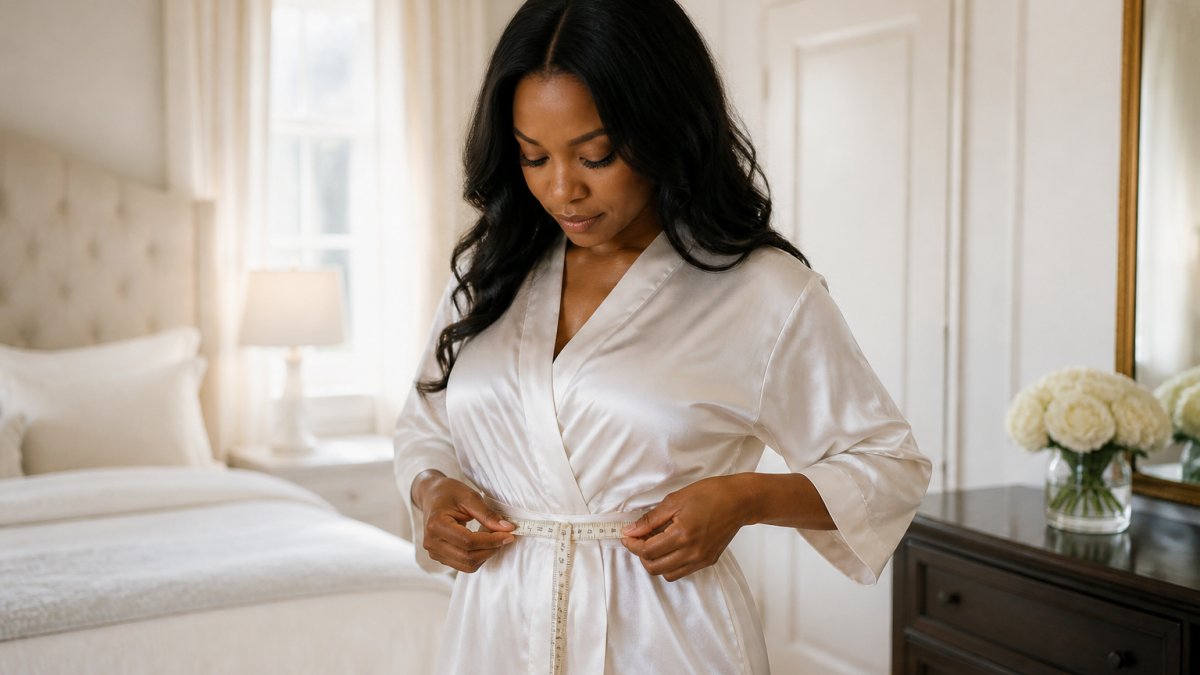
Write all six numbers down before you open a size chart.
How Should a Silk Robe Fit? Drape, Ease, and Wrap Coverage
A silk robe should skim your body with visible ease, never pull across the chest, and overlap enough at the front that the wrap stays closed when you move.
Why silk fit is its own category
- Low stretch: Silk has virtually no give along the warp and weft. If the bust is tight on the hanger, it will be tight on the body.
- Bias drape: Cut on the bias, silk stretches slightly diagonally and relaxes into the body's curves within minutes, so a robe that looks boxy on the hanger can look fluid on.
- Fabric weight (momme): A 22-momme charmeuse or crepe holds a line and resists clinging.
The three fit tests that actually matter
- The reach test: Raise both arms overhead. The front panels should not separate at the chest, and the belt should not ride up above the natural waist. If either happens, the robe is too small through the bust or too short through the torso.
- The sit test: Sit down and cross one leg. The hem should not pull tight across the thighs, and the front overlap should still cover the chest. Silk has no stretch to compensate, so a robe that passes standing but fails sitting is a size too small.
- The tie test: Tie the belt at your natural waist (the narrowest point, usually just above the navel), not at the ribcage or hips. A silk belt over smooth charmeuse can slip. If the knot slides within minutes of walking, the robe is too large through the waist or the belt too narrow for the fabric weight.
Wrap coverage: how much overlap is enough
A well-cut silk wrap robe should cross with roughly 4 to 6 inches of overlap at the chest when tied at the natural waist.
Coverage also depends on where the belt sits.
Fit by silhouette
- Kimono cut: Wide sleeves, straight fall, no shaped waist. More room through the shoulders and arms, less definition through the middle. Best if you carry width in the shoulders or want an unstructured drape.
- Wrap cut: Shaped by the belt, with front panels that cross. More definition, but less forgiving through the bust and waist because the fabric has no stretch to hide a tight measurement.
- Caftan or straight cut: Pullover or zip, no belt. Most forgiving through the middle, least adjustable if the shoulders or bust are off.
A note on layering
Silk Robe Length Guide: Choosing the Right Hem
A silk robe length guide comes down to height, torso length, and use, but the label alone will not tell you where the hem lands on you.
How to translate garment length to your body
- Measure your shoulder-to-hem target. Stand straight and have someone measure from the top of your shoulder (where the robe's shoulder seam would sit) straight down to where you want the hem to fall.
- Compare it to the robe's stated length. Most silk robes list a center-back length (from the base of the neck to the hem) or a shoulder-to-hem length. If it lists center-back length, subtract roughly 1 to 2 inches to approximate shoulder-to-hem.
- Adjust for heel height and posture. If you will wear the robe with slippers or barefoot, measure barefoot. If you plan to wear it over heels for a getting-ready moment, add the heel height to your target.
Length options and where they land
The Royal Wrap™ — Luxury Mulberry Silk Robe →
- Short robe (mid-thigh): Typically 30 to 34 inches shoulder-to-hem. Best for warm sleepers and quick coverage. On frames under about 5'4", it reads as a tunic; on taller frames, a short robe.
- Knee-length: Typically 38 to 42 inches shoulder-to-hem. The most versatile option. Works across most heights and reads polished enough for lounging or answering the door.
- Mid-calf: Typically 46 to 50 inches shoulder-to-hem. Classic and elegant, but can overwhelm petite frames unless cut narrow through the body. On taller frames, it often lands closer to the knee.
Sleeve length matters as much as hem length
A robe's sleeve length is measured from the shoulder seam down the outside of a slightly bent arm to the wrist bone.
How height changes the same robe
- Under 5'4": A knee-length robe often lands at mid-calf, and a mid-calf robe can reach the ankle. Size down in length, not width, if you want the hem where the label says.
- 5'4" to 5'8": Most labeled lengths land close to their stated target; this is where standard size charts are most accurate.
- Over 5'8": A knee-length robe can land above the knee, and a mid-calf robe can land at the knee. For true ankle coverage, look for a long robe with a shoulder-to-hem measurement of at least 54 inches.
Torso length, not just height
Two women the same height can have different torso lengths, which shifts where a hem lands.
Length and use case
- Sleep and lounging: Knee-length or mid-calf keeps the hem off the floor and out of the way.
- Getting ready: A short or knee-length robe is easier to move in while doing hair and makeup.
- Postpartum or recovery: Mid-calf or long gives more coverage and warmth without restricting movement.
Between Sizes? How to Decide Based on Fit Preference
When you land between two ranges, your fit preference breaks the tie. There is no universal right answer, only the one that matches how you want to feel.
- Choose the smaller range if you want a slim fit, plan to wear the robe belted and closed, and prefer the fabric to follow your shape.
- Choose the larger range if you want a relaxed fit, plan to layer it over sleepwear, or want generous wrap coverage for postpartum rest or cooler nights.
- Choose the larger range if you are taller than average, since length and sleeve measurements scale with size.
For postpartum recovery, a loose fit is almost always the better call. Your body is changing week to week, and a robe that accommodates that change will serve you far longer than one cut close.
Fit is only half the equation. Care matters too, because silk that shrinks or loses its finish will not fit the way it did on day one.
Conclusion: Your Silk Robe Should Feel Like It Was Made for You
Getting the size right is the difference between a robe you wear once and one you reach for every night. Measure honestly, match the range to your fit preference, and let silk fall beautifully.
At Crowning Legacy by Ms. Carla, our Royal Wrap™ is cut from 100% Grade 6A mulberry silk at 22 momme in M/L and XL/XXL, with continuous antique gold legacy swirl detailing and a matching silk belt, so the fit feels as considered as the fabric.
Frequently Asked Questions
Should you size up or down for a silk robe?
Size up if you want generous wrap coverage or plan to layer over pajamas. Size down only if you prefer a close, body-skimming fit and your measurements fall at the low end of a range. Silk has little stretch, so the robe will not give over time. When in doubt, choose the larger size; a silk robe that gaps at the chest is uncomfortable and exposes more than intended.
How do I measure myself for a silk robe?
Use a soft tape measure and wear light clothing. Measure your bust at the fullest part, your waist at the narrowest point, and your hips at the widest part. Keep the tape level and snug but not tight. Write down each measurement and compare them to the silk robe size chart. If your measurements span two sizes, decide based on how you want the robe to fit around the hips and chest.
How long should a silk robe be?
Your height matters: a mid-calf robe on a taller frame may hit closer to the ankle on a shorter frame. For postpartum rest or lounging, a longer hem offers more warmth and coverage. Check the garment length measurement against your own preferred hem point.
Can you wear a silk robe if you are between sizes?
Yes, but choose based on how you want the robe to feel. If you want a relaxed fit with room to move and full wrap coverage, go with the larger size. If you prefer a closer fit that still allows ease of movement, the smaller size may work. Silk has little stretch, so the robe will not expand with wear.
How should silk robe sleeves fit?
Sleeves should end at or just past your wrist bone without covering your hands. They should be loose enough to bend your arms comfortably but not so wide that they drag in water or food.
What should I check on a silk robe size chart?
Compare your bust, waist, and hip measurements to the chart's body measurements, not just the garment measurements. Look for the size range that includes your largest measurement. Check the robe length and sleeve length if listed, and note whether the chart uses body or garment measurements. A well-made chart will also indicate the fit type (slim, regular, or relaxed) so you know how much ease to expect.