


Table of Contents
- Silk Robe Sizing: Why the Right Fit Changes Everything
- How to Measure for a Robe: Your 3-Step Body Guide
- Active Fit vs. Lounging Fit: What Does Your Choice Say?
- Should I Size Up for a Silk Robe? The Drape Factor
- Silk Robe Length Guide: From Mini to Floor-Length
- Fabric, Shrinkage, and Care: How Wash Day Alters Your Sizing
- Conclusion: Your Measurements, Your Legacy Piece
- Frequently Asked Questions
Last Updated: September 7, 2026
Silk Robe Sizing: Why the Right Fit Changes Everything
Choosing the correct silk robe sizing is less about matching your standard clothing size and more about understanding how a garment's drape, cut, and fabric weight interact with your body. Most luxury robes fail to impress not because of poor quality, but because of poor fit: too tight restricts the breathability that makes mulberry silk exceptional, while too loose can feel sloppy rather than elegant.
At Crowning Legacy by Ms. Carla, we understand that the right fit transforms a robe from a simple garment into a ritual of self-regard. Silk robe sizing is a personalized decision, not a universal formula.
How to Measure for a Robe: Your 3-Step Body Guide
How to measure for a robe requires only a soft tape measure, a mirror, and about five minutes. Wear lightweight clothing or undergarments so the tape sits against your natural silhouette, and stand straight with your arms relaxed at your sides.
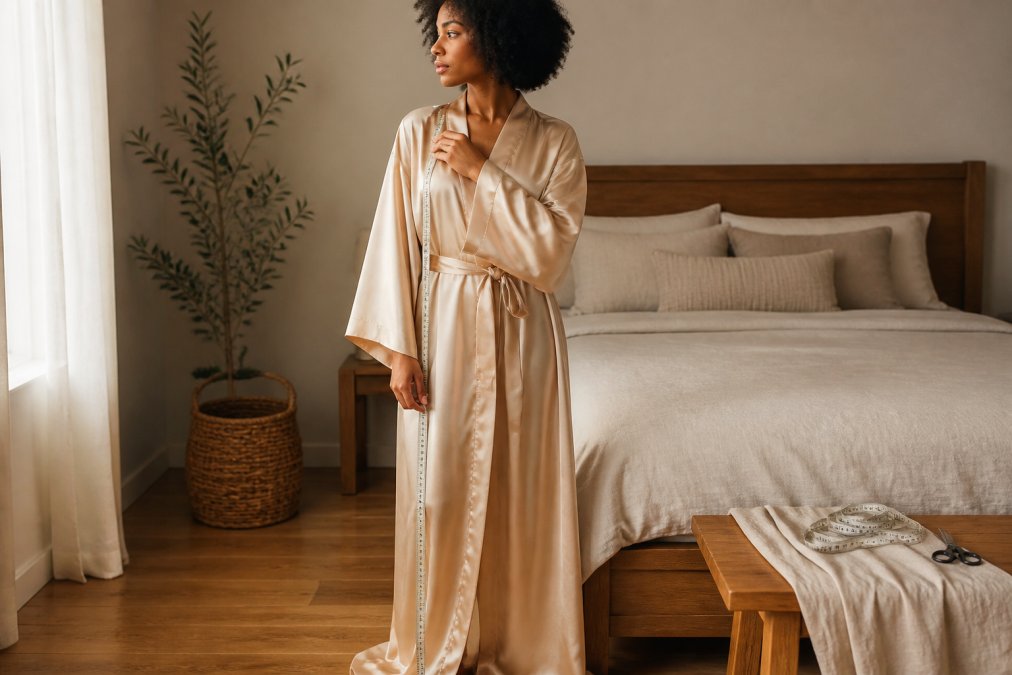
Step 1: Chest and Hip Width
Wrap the tape measure around the fullest part of your chest, keeping it level across your back and under your arms. Record this number, then do the same around the widest part of your hips. These two measurements determine the robe's body width, which is the primary factor in silk robe sizing. Most size charts list a range for each, so match both your chest and hip numbers to the same size column. If you fall between sizes, choose the larger option, since silk robes are designed to drape rather than cling.
Step 2: Translating Your Numbers to a Size Chart
A size chart is not a suggestion; it is the manufacturer's contract with your body. For a typical US size chart, a chest of 34-35 inches and hips of 38-39 inches corresponds to a size Small; a chest of 36-37 inches and hips of 40-41 inches maps to a size Medium; and size Large accommodates a chest of 38-40 inches and hips of 42-44 inches (nist.gov). These ranges are not universal, so always check the specific chart for the robe you are considering.
Your chest and hip measurements may not fall into the same size column. If your chest measures 36 inches (size Medium) but your hips measure 43 inches (size Large), you must choose the larger size. A robe that fits your chest but strains across the hips will pull at the closure and distort the drape; one that fits your hips but is too loose in the chest will gap at the neckline.
Step 3: Shoulder to Hem Length
Place the tape at the center of your shoulder seam and let it fall straight down to where you want the hem to land. For a knee-length robe, measure to mid-thigh. For a midi robe, measure to just below the knee. For a floor-length robe, measure to your ankle or the floor. This vertical measurement is critical because a robe's hemline defines its formality and its comfort. A robe that is too short can feel restrictive when you sit, while one that is too long becomes a tripping hazard on stairs.
Step 4: Sleeve Length
Start at the center of your back at the base of your neck and measure across your shoulder, down your arm, to your wrist bone. This gives you the full sleeve length, which is how most luxury manufacturers, including Crowning Legacy by Ms. Carla, construct their garments. The sleeve should end at your wrist when your arms are relaxed, allowing the cuff to fall gracefully without bunching. A sleeve that is too short pulls at the shoulder seam; one that is too long bunches when you reach for a cup of tea.
Active Fit vs. Lounging Fit: What Does Your Choice Say?
The distinction between an active fit and a lounging fit is the single most important decision in silk robe sizing, and it comes down to intention. An active fit follows your body's lines more closely, with a slimmer cut through the torso and arms, suiting women who plan to move through morning routines, tend to a newborn, or host a quiet breakfast.
A lounging fit, by contrast, prioritizes enveloping comfort, with a wider body, more generous sleeves, and a silhouette designed for reclining, reading, and slow afternoons. For postpartum mothers who spend long hours nursing or holding a sleeping baby, the lounging fit offers unrestricted ease; for women navigating perimenopause night sweats, the extra fabric allows better airflow.
Should I Size Up for a Silk Robe? The Drape Factor
Should I size up for a silk robe? The answer is almost always yes if you want a lounging fit, and no if you want an active fit. Silk's natural drape means it falls beautifully when given room to move; unlike stiff fabrics that hold their own shape, silk conforms to yours, so a size up will look intentional and luxurious, not oversized.
Sizing up is particularly beneficial for postpartum women whose bodies are still adjusting, or for anyone who values layering a silk robe over sleepwear or loungewear. A robe with a few extra inches in the chest and hip allows for this layering without strain on the seams. However, sizing up more than two sizes can result in the shoulder seams falling off your natural shoulder line, which compromises the robe's structure.
| Fit Preference | Size Adjustment | Best For | Shoulder Seam |
|---|---|---|---|
| Active Fit | True to measurement | Morning routines, hosting | At the natural shoulder edge |
| Lounging Fit | Size up 1-2 inches | Postpartum, reading, reclining | At the natural shoulder edge |
| Layering Fit | Size up 2-3 inches | Over sleepwear in cold months | Slightly past shoulder, still structured |
Silk Robe Length Guide: From Mini to Floor-Length
A silk robe length guide helps you translate your height and hem preference into a garment that feels balanced. The most common lengths are knee-length, midi, and floor-length, and each creates a different visual line. Knee-length robes hit mid-thigh and are practical for movement. Midi robes fall below the knee to mid-calf, offering a classic, polished look. Floor-length robes, which include our Royal Wrap™, extend to the ankle or floor and create the most dramatic, regal silhouette.
Height and Hemline Harmony
Your height determines which lengths will flatter you most. For women under 5'4", a floor-length robe can overwhelm a petite frame, so a midi length is often more harmonious. For women over 5'7", a knee-length robe can look disproportionately short, making the midi or floor-length the better choice. The hemline should clear the floor by at least one inch to prevent dragging on carpets and stairs.
Body Type Specific Length Adjustments
For petite frames (under 5'4"): A floor-length robe is not off-limits, but it demands precision. Measure from your shoulder to the floor and subtract two inches, not one, to ensure the hem clears the ground even when you wear slippers with a slight heel. A better alternative is a midi length that falls just below the knee, which elongates the leg line. If you have a shorter torso relative to your legs, choose a robe with a higher waist tie or a wrap style that cinches above your natural waist to create the illusion of length.
For tall frames (over 5'7"): Standard floor-length robes often fall at mid-calf, which reads as an unintentional crop. Look for robes labeled "tall" or "long," or measure from your shoulder to the floor and add one inch to ensure the robe reaches your ankle. A knee-length robe on a tall frame can look like a bolero jacket, so if you prefer that length, choose one with a more generous cut through the hips to balance your vertical line.
For plus-size bodies (typically size 18 and above): The length you choose interacts directly with your bust and hip circumference. A floor-length robe that fits your chest may pull across the hips and ride up when you sit, exposing your legs. Measure from your shoulder to the floor while seated, not standing, to ensure the hem covers you in your most common posture. A midi length that falls below the knee is often the most practical choice because it provides coverage without the risk of the hem catching under your weight when you stand.
Fabric, Shrinkage, and Care: How Wash Day Alters Your Sizing
Silk is a natural protein fiber, and its response to water and heat is a critical factor in silk robe sizing that most guides overlook. While high-quality mulberry silk, such as the Grade 6A 22 momme used in Crowning Legacy by Ms. Carla's collection, is weighted and woven to resist distortion, improper care can still cause subtle shrinkage or stretching.
The rule for preserving your robe's fit is to treat it as the delicate heirloom it is. Hand wash in cool water with a gentle silk-specific detergent, or use the delicate cycle in a mesh bag. Never wring the fabric; instead, press the water out gently and lay the robe flat to dry on a clean towel, reshaping the seams while it is damp. This practice, outlined in the fabric care guidelines from the Silk Association, prevents the fiber from contracting and maintains the garment measurements you originally selected.
Because silk is breathable and moisture-wicking, it also responds to how you store it. Hanging a damp robe on a wooden hanger can stretch the shoulders, so allow the robe to dry flat, then hang it on a padded hanger to maintain its shape between wears.
Conclusion: Your Measurements, Your Legacy Piece
Selecting the correct silk robe sizing is a matter of honoring your body's current shape, your intended use, and the garment's natural behavior. Take your chest, hip, shoulder-to-hem, and sleeve measurements. Decide whether you want an active or lounging fit. Consider how your height interacts with the hemline. And commit to the gentle care that keeps your robe true to its original form.
This is the philosophy behind every piece from Crowning Legacy by Ms. Carla. Our Royal Wrap™ Luxury Mulberry Silk Robe is cut to drape beautifully on a range of bodies, and our Legacy Set™ pairs the robe with the Whispered Crown™ bonnet for a complete ritual of rest. Crafted from 100% Grade 6A mulberry silk at 22 momme, these pieces are designed to be worn, inherited, and remembered. When you choose a robe that fits, you are not just buying sleepwear; you are investing in a garment that will hold you softly for years to come, as detailed in this guide to investing in quality loungewear. Add a piece that honors your measurements and your legacy.
Frequently Asked Questions
Does silk run big or small in robes?
Silk robes typically follow standard clothing sizes, but the drape of the fabric changes the feel. A size medium usually fits a standard medium. However, because silk is fluid, a robe that is technically your size can feel snug if you prefer an oversized lounging fit. Always compare your chest and hip measurements to the garment's size chart rather than relying on your usual dress size, as manufacturer specifications vary between brands.
What size robe is best for a 5'4" woman?
For a 5'4" woman, the best size depends on the length you want. A standard knee-length robe will fall around the upper thigh, while a midi style hits below the knee. If you prefer a floor-length, luxurious feel, you may need to size down or choose a petite option to avoid tripping. Focus on the shoulder-to-hem measurement on the size chart to ensure the hemline sits where you want it.
How should a luxury silk robe fit on the body?
A luxury silk robe should skim your body without pulling or gaping at the chest. The shoulder seam should align with your natural shoulder line, allowing your arms to move freely. The wrap style should overlap comfortably, secured by the tie closure. You should have enough room to layer a thin nightgown underneath, but the robe should not look boxy or oversized unless that is your chosen aesthetic.
Are there differences in sizing between kimono-style and traditional robes?
Yes. Kimono-style robes use a straight, boxy cut with wide sleeves, so they run more generously and offer a relaxed, oversized fit. Traditional robes with set-in sleeves and a shaped waist provide a more tailored silhouette. If you are between sizes, you might stay true to size for a kimono style, but consider sizing up for a fitted traditional robe to ensure the tie closure meets comfortably without strain.