


Table of Contents
- Mulberry Silk vs. Satin: What You're Actually Comparing
- Momme Weight Explained: Why It Decides Quality
- Skin, Hair, and the Case for Mulberry Silk
- Breathability, Thermoregulation, and Night Sweats
- Mulberry Silk vs Satin Pillowcase: A Direct Comparison
- Chemical Processing, Toxicity, and End-of-Life
- How to Wash Mulberry Silk Without Damaging It
- Price, Durability, and What You Actually Get
Last Updated: August 15, 2026
Mulberry Silk vs. Satin: What You're Actually Comparing
Most people shopping for a silk bonnet or robe are comparing two very different things without realizing it. Mulberry silk is a natural fiber. Satin is a weave structure. These are not the same category, and treating them as equivalent is the first mistake most buyers make.
At Crowning Legacy by Ms. Carla, we work exclusively with Grade 6A mulberry silk because the distinction between real silk and satin-finished synthetics is fundamental to how your skin, hair, and body respond to the fabric night after night.
What Mulberry Silk Is Made Of
Mulberry silk is a natural protein fiber produced by Bombyx mori silkworms fed exclusively on white mulberry leaves. The controlled diet produces filaments of exceptional uniformity with a smooth, continuous strand that gives mulberry silk its signature luster, tensile strength, and softness against skin.
The fiber is composed primarily of fibroin, a structural protein, coated in sericin, a natural gum largely removed during processing. What remains is a hypoallergenic, natural protein fiber that closely mirrors the amino acid profile of human skin. This biological similarity is the structural reason why mulberry silk does not trigger inflammatory responses the way synthetic fabrics can.
What Satin Actually Is
Satin is a weave pattern, not a fiber. It describes how threads are interlaced: long "floats" of thread run across the surface before looping under, creating a smooth, reflective face. That surface can be produced using any fiber, silk, polyester, nylon, or acetate.
The overwhelming majority of products marketed as "satin" in the sleep and haircare space are polyester satin. Polyester is a petroleum-derived synthetic that mimics the visual sheen of silk but shares none of its biological properties. Polyester does not breathe, does not regulate temperature, and does not absorb moisture like natural protein fibers do. The friction coefficient of polyester satin remains significantly higher than genuine mulberry silk.
Momme Weight Explained: Why It Decides Quality
Momme weight is the standard measurement for silk fabric density and separates informed buyers from everyone else.
Momme weight describes how much a standardized piece of silk fabric weighs in pounds. A higher momme number means more silk fiber per square meter, which translates directly to durability, opacity, and feel. Lightweight silk at 6-8 momme is appropriate for scarves. Bedding and sleepwear requires a minimum of 19 momme, and 22 momme is where genuine luxury begins.
The Royal Wrap™ robe and The Whispered Crown™ bonnet from Crowning Legacy by Ms. Carla are both crafted from 22 momme, Grade 6A mulberry silk. That specification matters for three practical reasons:

- Durability: Higher momme silk holds its structure through repeated hand washing without thinning or pilling
- Tactile quality: 22 momme silk has a substantial, weighted drape that lighter fabrics cannot replicate
- Thermoregulation: Denser fiber construction improves the fabric's ability to buffer temperature changes against your skin
Polyester satin has no momme equivalent. When a product listing lacks a momme weight, that absence is the answer.
Skin, Hair, and the Case for Mulberry Silk
The argument for mulberry silk over satin is most compelling when you examine what happens to your skin and hair during sleep.
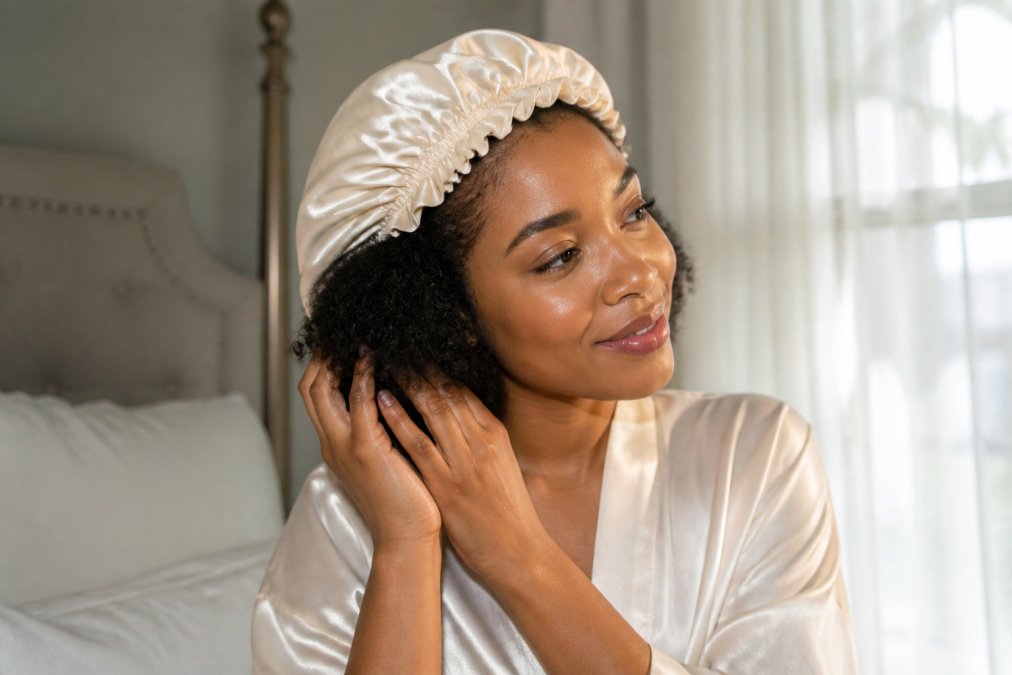
Friction Reduction and Hair Breakage
Friction is the primary mechanical cause of hair breakage, frizz, and edge damage during sleep. Every time your hair moves against a surface, the cuticle layer is disrupted. For textured, coily, and chemically processed hair, that disruption compounds nightly into visible damage.
Polyester satin reduces friction compared to cotton but still generates static electricity and has a higher friction coefficient than genuine silk. Mulberry silk's naturally smooth filament structure produces minimal friction against hair strands, keeping the cuticle flatter and moisture sealed inside the strand.
The Whispered Crown™ bonnet addresses a secondary friction problem most bonnets ignore: the elastic band. Elastic creates consistent tension and pressure at the hairline, damaging edges over time. The Whispered Crown™ uses extended mulberry silk ties instead of elastic, allowing a precise, adjustable fit that protects edges without compression.

Long-Term Skin Barrier Health
The skin barrier depends on moisture retention and minimal mechanical disruption to function properly. Synthetic fabrics like polyester satin do not absorb moisture; they trap it against the skin surface, creating a humid microclimate that can disrupt the skin's natural pH balance and contribute to congestion and irritation.
Mulberry silk's natural moisture absorption capacity draws excess moisture away from skin without stripping the hydration the skin barrier needs. The amino acids in the silk protein fiber are structurally similar to those found in the skin's natural moisturizing factors. Sleep lines, the creases formed by repeated facial compression against a rough surface, are a documented contributor to long-term skin changes. Silk's low friction coefficient reduces the mechanical pressure that creates and deepens those lines over years of sleep.
Breathability, Thermoregulation, and Night Sweats
Synthetic satin traps heat. Polyester fibers are non-porous and do not allow air circulation through the fabric structure, which means body heat accumulates between the fabric and your skin.
Mulberry silk's thermoregulation works through a different mechanism. Natural protein fibers are hygroscopic, meaning they absorb and release moisture vapor as conditions change. This creates a passive buffering effect: the fabric absorbs excess heat and moisture when you are warm, and releases it as conditions cool.
For women navigating perimenopause or postpartum hormonal changes, the difference between waking up drenched and sleeping through the night can come down to what is touching their skin. The breathability of genuine 22 momme mulberry silk is the physical consequence of sleeping inside a natural protein fiber rather than a petroleum-derived synthetic.
Mulberry Silk vs Satin Pillowcase: A Direct Comparison
The mulberry silk vs satin pillowcase debate comes down to what you are actually buying.
| Feature | Mulberry Silk (22 momme) | Polyester Satin |
|---|---|---|
| Fiber origin | Natural protein (Bombyx mori) | Petroleum-derived synthetic |
| Friction coefficient | Very low (smooth filament) | Low, but higher than silk |
| Thermoregulation | Yes, hygroscopic, breathable | No, traps heat and moisture |
| Hypoallergenic | Yes, natural protein fiber | Potentially irritating |
| Moisture absorption | Absorbs and releases moisture | Non-porous, traps moisture |
| Static electricity | Minimal | Generates static |
| Skin barrier impact | Supportive, amino acid affinity | Neutral to disruptive |
| Durability | High, 22 momme holds structure | Degrades faster, pills over time |
| Environmental end-of-life | Biodegradable | Non-biodegradable (microplastics) |
| Price range | Higher investment | Lower upfront cost |
Polyester satin costs less upfront. Mulberry silk delivers on every functional metric that matters for skin, hair, and sleep quality. For a pillowcase you will use every night for years, the cost-per-use calculation shifts significantly in silk's favor.
Chemical Processing, Toxicity, and End-of-Life
Polyester satin production involves petrochemical processing, synthetic dyes, and finishing chemicals that can include formaldehyde-based resins. According to the Oeko-Tex Standard 100 certification database, many synthetic textiles contain residual chemicals from processing that remain in the fabric through multiple washes. Sensitive skin, particularly postpartum skin, can react to these residues.
Mulberry silk, when processed without harsh chemical additions, is naturally hypoallergenic. Finished mulberry silk fabric contains minimal sericin and is well-tolerated by most sensitive skin types.
Polyester satin is a plastic textile that sheds microplastics with every wash, contributing to water system contamination. At the end of its useful life, polyester fragments into smaller plastic particles. Mulberry silk is a natural protein fiber that biodegrades fully in soil without persistent environmental impact.
How to Wash Mulberry Silk Without Damaging It
Knowing how to wash mulberry silk properly is what separates a piece that lasts one season from one that lasts a generation.
Mulberry silk care checklist:
- Hand wash in cool water (below 85°F) or use a machine's delicate cycle in a mesh laundry bag
- Use a pH-neutral, silk-specific detergent; standard detergents are alkaline and degrade the fibroin protein
- Submerge and gently agitate; never scrub or twist the fabric
- Rinse thoroughly in cool water until no soap remains
- Press water out gently between two clean towels, never wring
- Dry flat or hang in shade; direct sunlight yellows silk over time
- Iron on the lowest setting with a pressing cloth, or steam lightly
- Store folded in breathable cotton or linen, avoid plastic bags
According to textile care guidance from the American Cleaning Institute, protein fibers like silk require pH-neutral cleaning agents to maintain their structural integrity. Alkaline detergents break down the fibroin protein at the molecular level, causing the fabric to weaken and lose luster.
Treated correctly, 22 momme mulberry silk at Grade 6A is a durable textile designed to be worn, washed, and kept for years.
Price, Durability, and What You Actually Get
Genuine mulberry silk sleepwear costs more upfront than polyester satin. The question is what you are actually purchasing over time.
Polyester satin degrades. The weave structure pills, the sheen dulls, and the fabric thins with washing. A satin bonnet typically needs replacing within months of regular use. A 22 momme mulberry silk piece, cared for properly, maintains its structure, luster, and protective properties for years and can be passed down.
The Legacy Set™ from Crowning Legacy by Ms. Carla, which includes The Royal Wrap™ robe and The Whispered Crown™ bonnet, both in Grade 6A, 22 momme mulberry silk, is priced at $333. The Royal Wrap™ robe is available individually at $280, and The Whispered Crown™ bonnet at $95. These are deliberate investments in a material that performs differently, lasts longer, and carries a different relationship to the body than polyester satin.

According to fiber durability research from the Textile Research Journal, natural protein fibers with high filament uniformity demonstrate superior tensile strength retention over repeated laundering compared to synthetic weaves of equivalent weight.
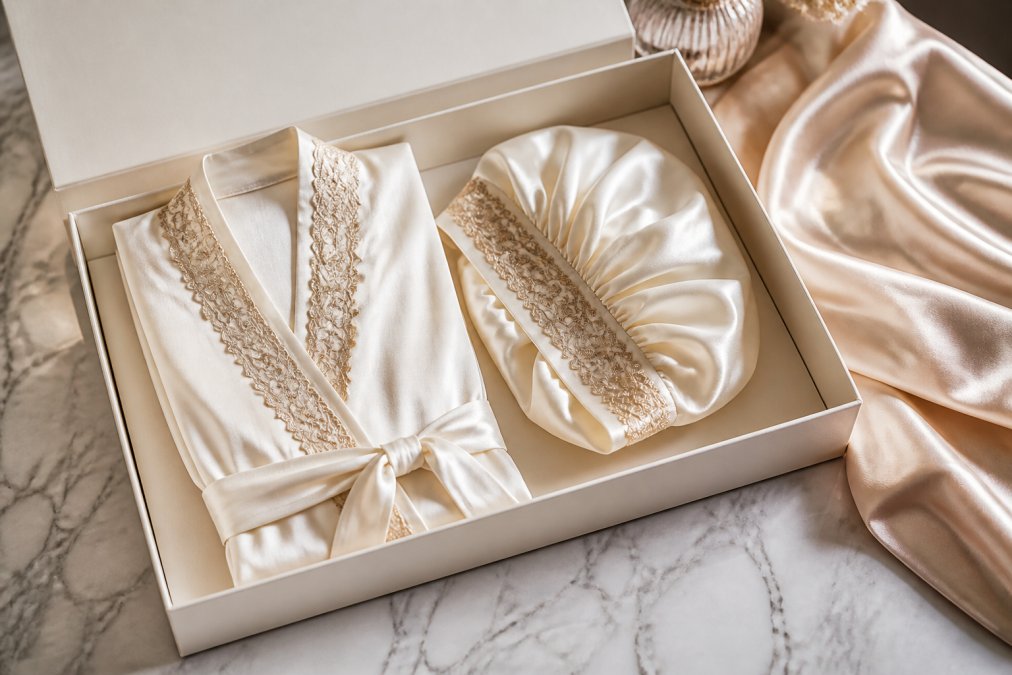
| Product | Price | Silk Grade | Momme | Best For |
|---|---|---|---|---|
| The Whispered Crown™ Bonnet | $95 | 6A | 22 | Hair protection, edges, night wear |
| The Royal Wrap™ Robe | $280 | 6A | 22 | Full-body comfort, postpartum, gifting |
| The Legacy Set™ (Bonnet + Robe) | $333 | 6A | 22 | Complete experience, heirloom gifting |
The question is not whether mulberry silk costs more than polyester satin. It does. The question is whether you want a fabric that performs, protects, and lasts.
Choosing between mulberry silk and polyester satin is ultimately a choice about what you believe your rest is worth. Synthetic satin offers a visual imitation of luxury without the biological properties that make genuine silk meaningful for skin barrier health, thermoregulation, and hair integrity. For women navigating postpartum recovery, perimenopause, or simply protecting their hair and skin, that difference is significant. Crowning Legacy by Ms. Carla was built on this distinction, every piece in the collection is crafted from 100% Grade 6A, 22 momme mulberry silk, designed to be worn with intention and kept for generations. Explore The Legacy Set™ and experience what genuine mulberry silk feels like against your skin.
Frequently Asked Questions
Is mulberry silk actually better for hair health than satin?
Mulberry silk is a natural protein fiber with a smooth, uniform filament structure that produces a low friction coefficient against hair strands. Polyester satin, despite its slick appearance, has a rougher surface at the microscopic level that creates more friction over hours of sleep. That friction causes hair breakage, frizz, and disrupted curl patterns, especially for textured hair types. Mulberry silk also does not strip moisture from hair the way synthetic fabrics can, making it the superior choice for overnight hair protection.
How can you tell the difference between real mulberry silk and synthetic satin?
The burn test is the most reliable method: real mulberry silk smells like burning hair and leaves a crushable ash, while polyester satin melts, beads, and smells chemical. You can also check the label for '100% mulberry silk' and a momme weight (19-25 momme indicates genuine, quality silk). Authentic mulberry silk has a soft, matte-to-lustrous sheen that shifts with light; polyester satin has a flat, uniform shine. Price is also a signal, genuine 22-momme Grade 6A mulberry silk costs significantly more than synthetic alternatives.
Does satin offer the same temperature-regulating benefits as mulberry silk?
No. Satin made from polyester is a synthetic weave that traps heat and does not absorb moisture, which makes it uncomfortable during warm nights or for anyone experiencing night sweats. Mulberry silk is a natural protein fiber that actively regulates body temperature, it breathes in warm conditions and retains warmth when cool. This thermoregulation is a structural property of the silk filament itself, not a finish applied during manufacturing, so it does not wash out over time the way treated synthetics can.
What are the main disadvantages of mulberry silk compared to satin?
Mulberry silk costs significantly more than polyester satin and requires more careful maintenance, hand washing or a gentle machine cycle in cold water with a pH-neutral detergent, away from direct sunlight when drying. It can also be damaged by chlorine, harsh detergents, and prolonged heat. Satin, particularly polyester satin, is machine-washable and inexpensive. For anyone prioritizing skin barrier health, hair protection, breathability, and long-term durability, the care requirements of mulberry silk are a worthwhile trade-off rather than a true disadvantage.
This article was written using GrandRanker