


Table of Contents
- How Silk Regulates Body Temperature During Night Sweats
- Why Mulberry Silk Is Better Than Satin for Hot Flashes
- Benefits of Mulberry Silk for Skin and Hair While You Sleep
- Silk vs. Bamboo vs. Tencel: Which Cooling Fabric Wins?
- How to Choose Silk Bedding and Nightwear for Perimenopause
- Caring for Your Silk Pieces So They Last
- Conclusion: Invest in Sleep That Honors Your Body
- Frequently Asked Questions
Last Updated: September 5, 2026
Waking up drenched in sweat is exhausting, but the right bedding can make a difference. Silk is one of the most effective materials for managing perimenopause night sweats because it naturally regulates body temperature and wicks moisture away from the skin. At Crowning Legacy by Ms. Carla, we craft luxury mulberry silk pieces designed specifically for women who refuse to let hormonal changes steal their rest.

Declining estrogen affects the hypothalamus, your body's internal thermostat, leading to vasomotor symptoms where blood vessels dilate suddenly and trigger a wave of heat. Your body sweats to cool down, which is why you wake up damp and chilled. The fabric you sleep in either amplifies this cycle or helps break it.
Below, we'll walk through exactly how silk supports thermoregulation, why mulberry silk outperforms satin, and how to choose pieces that will carry you through the night in comfort.
How Silk Regulates Body Temperature During Night Sweats
Silk's thermoregulatory advantage is rooted in its physical and chemical structure. Mulberry silk, a natural protein fiber composed primarily of fibroin wrapped in sericin, is inherently breathable and hygroscopic, meaning it can absorb and release moisture vapor from the surrounding air. This property buffers your microclimate, preventing the sudden chill that follows a hot flash.
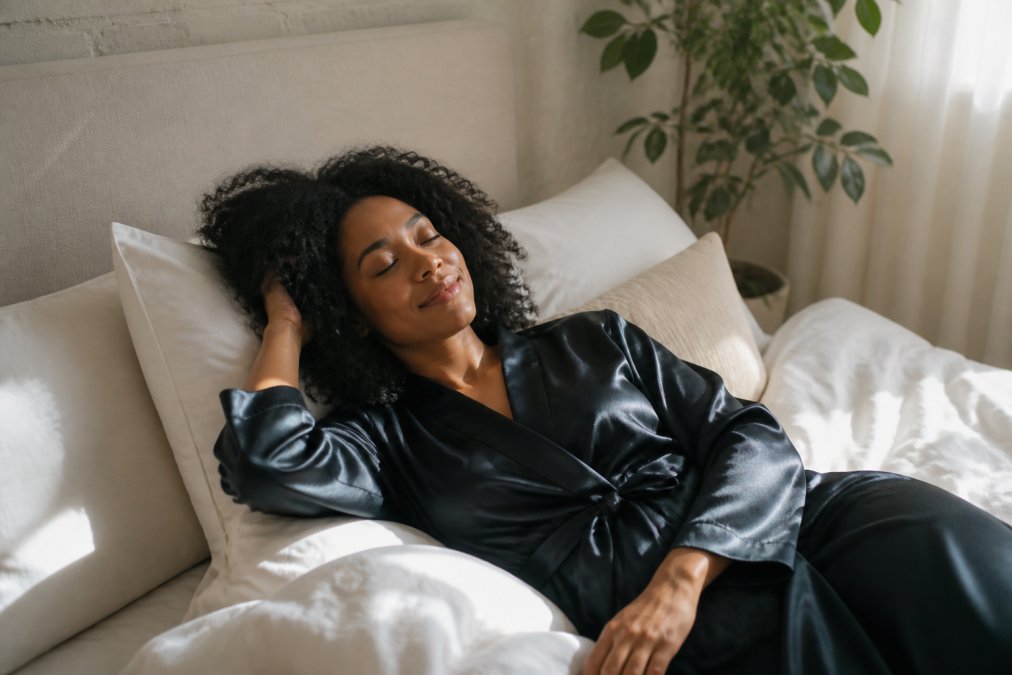
When a vasomotor episode triggers a surge of heat, your body's first response is vasodilation, blood vessels near the skin widen to release heat, and you begin to perspire. Silk's fibroin fibers have a high surface area and a unique capillary action that draws moisture away from the skin and spreads it across the fabric's surface, where it evaporates rapidly. This is fundamentally different from synthetic fibers like polyester, which are hydrophobic and trap moisture against the skin, creating a damp, clammy feeling that can make you feel colder once the flash subsides.
Silk also mitigates the 'post-flash chill,' where the body's core temperature drops below its set point after a flash, leading to shivering and disrupted sleep. Because silk does not cling to wetness, it prevents the rapid evaporative cooling of your skin that triggers that secondary chill, allowing for a gradual, even release of heat and moisture.
Silk's protein structure is similar to human skin's keratin, so it interacts with your body's sensory receptors differently than plant-based or synthetic fibers. It lacks the 'prickly' or 'sticky' feel that can exacerbate the discomfort of a hot flash, providing a neutral sensory input that allows you to remain calmer and more likely to drift back to sleep.
Silk also excels at passive humidity control. Unlike cotton, which can absorb up to 27 times its weight in moisture and feel heavy and wet, silk absorbs up to 30 percent of its weight without feeling damp to the touch (peer-reviewed research). Cotton, once wet, stays wet and can pull heat away from your body rapidly, causing you to wake up shivering. Silk releases that moisture into the air more readily, keeping the fabric feeling dry even after a significant sweating episode.
Silk's high air permeability is due to the irregular, triangular cross-section of the fibroin fibers, which creates microscopic air pockets for excellent airflow while still providing insulation. This dual-action, cooling when you are hot and insulating when you are cold, makes silk a year-round fabric for women in perimenopause.
Why Mulberry Silk Is Better Than Satin for Hot Flashes
The question of why mulberry silk is better than satin comes down to the raw materials. Satin is a weave, not a fiber; it can be made from polyester, nylon, or other synthetics that trap heat and block airflow. Mulberry silk is a natural protein fiber produced by silkworms fed exclusively on mulberry leaves, creating a fabric that is genuinely breathable and moisture-wicking.
Synthetic satin often feels smooth at first touch, but it lacks the thermoregulating properties that make silk effective for night sweats. Polyester fibers do not absorb moisture; they trap it against your skin, intensifying the discomfort of a hot flash. Mulberry silk, by contrast, absorbs up to 30 percent of its weight in moisture without feeling damp.
For women experiencing perimenopause night sweats, this difference is not academic. It is the difference between waking up drenched and waking up dry. Silk's temperature management also extends to cooler months, when it helps retain body heat without causing overheating.
Benefits of Mulberry Silk for Skin and Hair While You Sleep
The benefits of mulberry silk for skin and hair extend far beyond temperature regulation. As estrogen declines, skin naturally loses elasticity and density, becoming drier and more prone to irritation. Silk's smooth surface creates minimal friction, which is essential for protecting both your skin and your hair while you sleep.
Cotton pillowcases and nightwear can tug at your skin, contributing to fine lines and exacerbating conditions like eczema. Silk's slippery texture allows your skin to glide without pulling, reducing the mechanical stress that accelerates visible aging. Its hypoallergenic properties also resist dust mites and mold that can trigger irritation.
Your hair also benefits significantly. Textured hair, whether coily, curly, or relaxed, is especially vulnerable to breakage during sleep. Cotton absorbs moisture from your strands, leaving them dry and brittle, while friction causes split ends and frizz. Silk bonnets and pillowcases help your hair retain its natural oils, keeping your edges intact and extending the life of your hairstyles.
Silk vs. Bamboo vs. Tencel: Which Cooling Fabric Wins?
Most articles on cooling fabrics for night sweats stop at 'silk is best.' But a truly informed choice requires understanding how silk stacks up against bamboo and Tencel (lyocell). Each fabric has a distinct fiber structure, moisture management profile, and environmental footprint that matters for different priorities.
The Science of Moisture Management
The key metric for night sweats is 'moisture vapor transmission rate' (MVTR), how quickly a fabric moves moisture vapor away from the skin. Silk has a naturally high MVTR due to its protein structure. Tencel lyocell, made from eucalyptus wood pulp, is engineered to have excellent MVTR as well, often rivaling silk in lab tests. 'Bamboo' fabric, however, is almost always bamboo viscose (rayon), a process that strips away the plant's natural properties, leaving a fiber that is essentially rayon with a decent but often lower MVTR.
The Sensory and Skin Interaction Difference
Where silk diverges from both bamboo and Tencel is in its interaction with the skin's sensory system. Perimenopause often brings heightened skin sensitivity and a lower tolerance for textures that feel 'scratchy' or 'synthetic.' Silk's protein fibers are smooth and round, creating a friction coefficient significantly lower than bamboo or Tencel. This reduces the mechanical irritation that can trigger a histamine response or exacerbate conditions like eczema. Tencel fibers are smooth but can feel 'crisper' or more 'paper-like' to some women, while bamboo viscose can feel 'slippery' in a way reminiscent of synthetic satin.
The Sustainability and Ethics Question
Bamboo is often marketed as the 'eco-friendly' choice, but the viscose process requires heavy chemical processing, including carbon disulfide, which is toxic to workers and the environment if not properly managed. Tencel lyocell is a more responsible choice because its manufacturing process uses a closed-loop system that recycles 99% of the solvent (europa.eu). Silk's environmental footprint is more complex: it is a natural, biodegradable protein fiber, but conventional production involves boiling silkworms alive in their cocoons. For ethically-minded consumers, 'peace silk' or 'ahimsa silk' allows the moth to emerge before the cocoon is harvested, though this produces a slightly shorter, less uniform fiber that is often less durable.
A Practical Comparison for Night Sweats
| Fabric | Fiber Type | Moisture Wicking | Sensory Feel | Skin Sensitivity | Sustainability | Durability |
|---|---|---|---|---|---|---|
| Mulberry Silk | Natural Protein | Excellent | Smooth, weightless | Excellent (hypoallergenic) | Complex; look for peace silk or transparent supply chains | High with care |
| Tencel (Lyocell) | Semi-Synthetic (Wood Pulp) | Excellent | Smooth, crisp | Good | Excellent (closed-loop process) | Medium-High |
| Bamboo (Viscose) | Semi-Synthetic (Rayon) | Good | Soft, sometimes slippery | Good | Questionable (chemical processing) | Medium |
The Verdict for Perimenopause
If your primary concern is the sensory experience of a hot flash, the feeling of sweat on your skin and the need for a calming, non-irritating fabric, silk is the superior choice. If your primary concern is environmental impact, Tencel lyocell is a strong, more easily verifiable alternative. Bamboo viscose, despite its marketing, is not a clear winner on either performance or sustainability. Consider what you value most: silk for the ultimate skin and sensory experience, Tencel for a more straightforwardly sustainable option, and bamboo only if you find a brand that uses a closed-loop lyocell process (often labeled 'bamboo lyocell') rather than viscose.
Ultimately, no fabric will stop a hot flash from occurring. But the right fabric can determine whether you wake up drenched and chilled, or whether you sleep through the event with minimal disruption. Silk offers the most comprehensive package for the temperature dysregulation, skin sensitivity, and sensory processing changes that characterize perimenopause.
How to Choose Silk Bedding and Nightwear for Perimenopause
Choosing the right silk pieces for perimenopause night sweats requires attention to three factors: silk grade, momme weight, and construction. Grade 6A is the highest quality classification for mulberry silk, indicating long, uniform fibers that produce a smoother, more durable fabric. A 22 momme weight offers the ideal combination of breathability and longevity for sleepwear and bedding.
When selecting a silk robe or nightgown, consider how it fits and moves with your body. A robe that is too tight can trap heat, while one that drapes loosely allows for better air circulation. The Royal Wrap™ from Crowning Legacy by Ms. Carla, crafted from 100% Grade 6A mulberry silk at 22 momme, is designed to feel weightless against your skin while providing full coverage and elegance.
For hair protection, a properly constructed silk bonnet is essential. Many women with thick or coily hair struggle with bonnets that slip off during the night. Look for a bonnet with a secure yet gentle elastic band and double-layer construction, like The Whispered Crown™, which stays in place without creating pressure marks or pulling at your hairline.

Caring for Your Silk Pieces So They Last
Silk is an investment, and like any heirloom-quality item, it rewards proper care with years of service. The most important rule is to avoid harsh detergents and high heat, as regular laundry detergent can strip the fibers of their natural luster and cause them to weaken over time.
Hand washing in cool water with a gentle silk-specific cleanser is the safest method. If you prefer machine washing, use a mesh laundry bag and select the delicate cycle with cold water. Never wring or twist wet silk; instead, gently press out excess water and lay the piece flat to dry away from direct sunlight.
When ironing, use the lowest heat setting and always place a pressing cloth between the iron and the silk. Many women find that hanging silk garments in a steamy bathroom removes wrinkles without any direct heat. Store your silk pieces flat or on padded hangers in a cool, dry place, and consider wrapping them in a cotton garment bag to protect against dust.
Conclusion: Invest in Sleep That Honors Your Body
Perimenopause is a season of profound change, and your sleep environment should be a sanctuary that supports you through it. The benefits of silk for perimenopause night sweats are clear: natural temperature regulation, moisture-wicking properties, and gentle protection for your skin and hair. Choosing quality silk is not an indulgence; it is an act of self-care that honors the body you inhabit.
At Crowning Legacy by Ms. Carla, we believe that luxury should be functional and that true elegance endures. Our mulberry silk pieces, including The Royal Wrap™ robe and The Whispered Crown™ bonnet, are crafted from 100% Grade 6A mulberry silk at 22 momme, designed to be worn, inherited, and remembered. The Legacy Set™ pairs both pieces for a complete sleep experience that addresses night sweats from every angle.

Invest in sleep that honors your body and your legacy. Get started with Crowning Legacy by Ms. Carla and discover the difference that true mulberry silk makes.
Frequently Asked Questions
Do silk sheets really help with night sweats?
Yes. Mulberry silk is a natural temperature regulator. Its protein fibers absorb and release moisture quickly, so when you sweat, the fabric wicks dampness away from your skin instead of trapping it like cotton or synthetic blends. This evaporation helps cool your body faster during a hot flash. Silk also maintains a steady microclimate against your skin, reducing the sudden chill that often follows a sweating episode.
Is silk better than satin for managing hot flashes?
Yes, especially if the satin is polyester. Real mulberry silk is breathable and moisture-wicking, while synthetic satin traps heat and dampness against your skin. Silk also contains natural proteins that are gentle on sensitive, overheated skin. For night sweats, 100% mulberry silk with a 22 momme weight offers a good combination of breathability and durability.
What momme count should I look for in silk for night sweats?
Look for 22 momme or higher. Momme count measures silk density. Higher momme silk is generally more durable and can be effective at regulating temperature. Lower momme silk (under 19) is lighter but may not manage moisture as effectively. Grade 6A mulberry silk at 22 momme is considered luxury quality.
Can silk help with skin irritation during perimenopause?
Yes. Silk is hypoallergenic and naturally resistant to dust mites and mold. Its smooth surface creates less friction than cotton, which matters because declining estrogen during perimenopause reduces skin elasticity and density, making skin more prone to irritation. Silk's fibers also contain amino acids that can help retain moisture, though a primary benefit is reduced friction and irritation while you sleep.
This article was written using GrandRanker