


Last Updated: November 11, 2026
Quick Summary
A silk bonnet for arthritis-friendly dressing should have long adjustable ties, a roomy cut, lightweight smooth silk, and no metal hardware. Long silk ties let you loop and tie loosely in front, avoiding the stretching and pinching that elastic bands and drawstrings demand of stiff hands.
- Tie the bonnet in front at eye level so you don't lift your arms high.
- For wheelchair use, choose ties long enough to bring forward into your lap.
- Tying too tight to stop slipping is the most common mistake and causes headaches.
- Short hair needs a closer cut and double-layer silk for weight and grip.
- The Whispered Crown uses double-layer Grade 6A mulberry silk at 22 momme.
Table of Contents
- Why a Silk Bonnet Works Better When Hands Are Stiff
- Features That Make a Silk Bonnet Easier to Put On With Arthritis
- A Silk Hair Wrap for Wheelchair Users: Fit, Fabric, and Reach
- The Best Silk Hair Wrap for Wheelchair Users Holds Still All Night
- Silk Hair Wrap for Sleeping Short Hair: Less Bulk, More Grip
- Silk Hair Wrap for Sleeping Long Hair: Room to Gather and Tie
- Choosing Your Arthritis-Friendly Silk Bonnet
- Frequently Asked Questions
Why a Silk Bonnet Works Better When Hands Are Stiff
A silk bonnet for arthritis-friendly dressing solves a problem most hair accessories create: the fight to get them on. Many women whose hands ache, swell, or simply will not close the way they used to find bonnets a daily struggle. A bonnet that demands fine pinching and tight knots becomes a nightly battle.
Silk helps because it is smooth. There is no friction dragging against your hair or your fingers. The fabric glides, so you are not wrestling it into place. That matters more than most guides admit.
The Closure Is the Whole Game
The closure is often the real reason a bonnet is hard to use with stiff hands.
An elastic band has to be stretched wide and pulled down over your head. That takes grip strength and a wide reach. A drawstring needs small, precise pinches. Both ask a lot of hands that hurt.
Long silk ties change the math. You loop, you pull, you adjust. No stretching, no pinching, no force. If you take one thing from this guide, take that.
Features That Make a Silk Bonnet Easier to Put On With Arthritis
A silk bonnet that suits arthritis-friendly dressing typically has long adjustable ties, a roomy cut, smooth lightweight silk, and no metal hardware. Each one removes a small demand on your hands. Together, they turn a two-minute struggle into a ten-second habit.
Look for these before anything else:
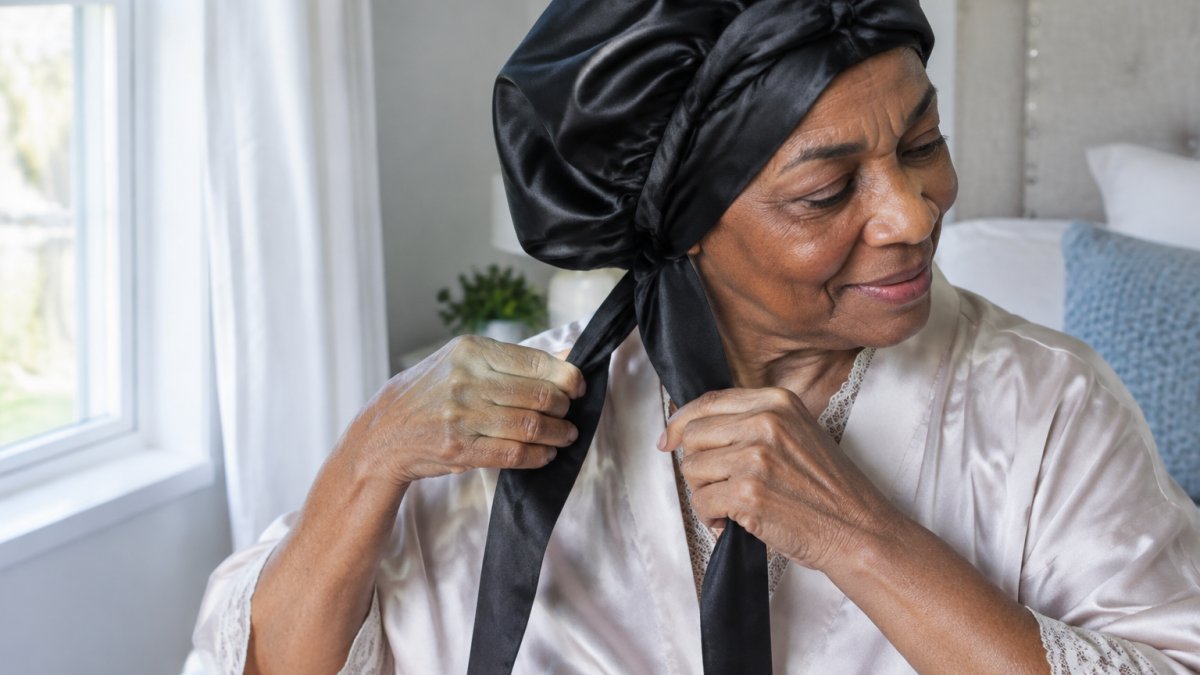
- Extended ties you can wrap loosely and tie in front, where you can see them
- Generous sizing so the bonnet slides on instead of stretching over
- Lightweight silk that does not drag or need two hands to guide
Ties, Bands, and What Each One Demands of Your Hands
Different closures suit different hands. Here is the honest breakdown.
| Closure Type | What Your Hands Must Do | Best For |
|---|---|---|
| Wide elastic band | Stretch and pull over head | Strong grip, full reach |
| Drawstring | Pinch and pull small cord | Moderate dexterity |
| Long silk ties | Loop and tie loosely | Stiff or painful hands |
| Snap or clip | Press small hardware | Rarely ideal |
If your hands are stiff in the morning, ties win. You can tie them in front, at eye level, without lifting your arms high. For a step-by-step walkthrough, see our guide on putting on a silk hair wrap with limited hand mobility. And if you want to compare closure styles across several options, our roundup of silk bonnet styles for hair protection lays them side by side.
A Silk Hair Wrap for Wheelchair Users: Fit, Fabric, and Reach
A silk hair wrap for wheelchair users has one extra job: it must go on without standing, twisting, or reaching behind the head. That rules out a lot of bonnets before fabric even enters the conversation.
Seated dressing changes the angles. You cannot lean forward and shake a bonnet down. You cannot reach up and back to tie anything. So the wrap has to come to you.
Three things make that possible:
- Ties long enough to bring forward into your lap
- A cut that opens wide so it drapes on rather than pulls on
- Fabric light enough to guide with one hand while the other rests
Silk's smooth surface can help it slide over hair with less snagging. If you want the fuller case for overnight silk, our article on the benefits of silk hair wraps for overnight protection covers fit and fabric in more depth.
The Best Silk Hair Wrap for Wheelchair Users Holds Still All Night
The best silk hair wrap for wheelchair users is the one that stays put without pressure. Movement in bed, transfers, and repositioning all test a bonnet. A loose wrap slips. A tight one leaves marks.
The answer is adjustable tension. You want ties you can snug to your own comfort, not a fixed band that decides for you. Tie it firm enough to hold, loose enough to forget.
Watch out: tying too tight to stop slipping is the most common mistake. It causes headaches and dents your edges. If your bonnet slides, size up or add a second wrap of the tie, not more force.
Silk Hair Wrap for Sleeping Short Hair: Less Bulk, More Grip
Short hair needs less room and more hold. A silk hair wrap for sleeping short hair should sit close to the head, with no excess fabric to bunch or shift. Too much material and the wrap slides off by morning.
What to look for with short hair:
- A closer cut that follows the head shape
- Ties that adjust down rather than a fixed band
- Double-layer silk for a little weight and grip
That last point matters. A single thin layer floats. A double layer rests. Our Whispered Crown™ uses double-layer Grade 6A mulberry silk at 22 momme.
Silk Hair Wrap for Sleeping Long Hair: Room to Gather and Tie
Long hair flips the priority. Now you need room. A silk hair wrap for sleeping long hair must hold a full gather of hair without pulling at the scalp or leaving the ends exposed.
Gather first, then wrap. Coil your hair loosely at the crown, slide the bonnet on, and tie with slack. Tight gathers cause tension at the hairline, and that is where breakage starts.
Sizing is where long hair gets tricky. If you are unsure which size gives you enough room to gather and tie, our guide on choosing the right size mulberry silk bonnet for long hair walks through it.
Choosing Your Arthritis-Friendly Silk Bonnet
Start with your hands, not the color. Ask three questions: Can I tie this in front? Can I get it on while seated? Does it stay without squeezing? If the answer to all three is yes, you have found your bonnet.
The Whispered Crown™ uses extended mulberry silk ties, so you can adjust the fit with precision. The double-layer Grade 6A mulberry silk is breathable, and mulberry silk is ideal for sensitive hair and scalp.
You can see the full details and closure on The Whispered Crown™ luxury mulberry silk bonnet.

One more thing worth knowing. Mulberry silk is described as temperature-regulating and protective against friction, which may matter if night sweats or a sensitive scalp keep you awake. A bonnet you can put on without pain is the point. A bonnet you want to keep is the bonus.
Stiff hands should not cost you your nighttime routine. At Crowning Legacy by Ms. Carla, we make mulberry silk bonnets with extended ties, double-layer Grade 6A silk, and no elastic to fight. You get a bonnet you can tie in front, adjust to your comfort, and keep for years. Explore the collection and find the piece you will wear, inherit, and remember.
Frequently Asked Questions
What features make a silk bonnet easier to put on with arthritis?
The closure is often the most important factor for stiff hands. Extended silk ties you can loop and knot loosely are easier to manage than a tight elastic band you have to stretch over your head. Look for double-layer mulberry silk, which holds its shape without pressure, and a generous cut so you are guiding fabric rather than fighting it. The Whispered Crown™ from Crowning Legacy uses extended mulberry silk ties, which let you adjust the fit with precision.
Are silk bonnets with adjustable closures easier to wear?
Adjustable ties can be easier for many people with hand stiffness. An adjustable tie lets you set the fit once and repeat the same motion each night, rather than stretching a fixed band over your hair every time. If your grip is limited, tie the knot loosely at the front where you can see and reach it.
Is a silk hair wrap suitable for wheelchair users?
Fit and comfort depend on individual needs, and the wrap should stay put without constant readjusting. A silk hair wrap for wheelchair users needs to survive pressure against a headrest and the movement of transferring in and out of the chair. Check that the wrap covers the crown and edges fully, since rubbing against a headrest is where friction damage happens.
How do I choose a silk bonnet for short or long hair?
For short hair, choose a closer-fitting wrap with less fabric volume so it does not slide off during the night. For long hair, you need enough room to gather everything at the crown before tying, otherwise the bonnet pulls at your hairline. In both cases, confirm the silk is 100% mulberry silk rather than satin polyester, and check the momme weight: 22 momme double-layer silk is a sturdier option than thinner single-layer fabric.
