


Table of Contents
- Why a Silk Hair Wrap Belongs in Your Overnight Routine
- How Silk Reduces Friction, Frizz, and Breakage While You Sleep
- Moisture Retention and Hydration: Keeping Strands Soft Overnight
- Benefits for Curls, Waves, and Textured Hair
- How to Wrap Hair for Sleeping: Step-by-Step by Length and Texture
- Silk Hair Wrap vs Silk Pillowcase: Which Protects Better?
- Mulberry Silk vs Satin for Hair: What the Label Doesn't Tell You
- How to Care for a Silk Bonnet So It Lasts for Years
- Frequently Asked Questions
Last Updated: October 21, 2026
Why a Silk Hair Wrap Belongs in Your Overnight Routine
You spend hours on wash day, then undo half of it overnight. That is the quiet problem a silk hair wrap solves: what touches your hair for eight hours matters as much as what you put on it during the day. At Crowning Legacy by Ms. Carla, we build our sleepwear around that principle. A silk hair wrap is a soft fabric covering worn over the hair at night to reduce friction, hold in moisture, and protect styles.
How Silk Reduces Friction, Frizz, and Breakage While You Sleep
Cotton pulls. Silk glides. That is the short version.
- Friction: Cotton fibers grip hair strands and create drag as you turn.
- Frizz: That drag lifts the cuticle and roughens the surface.
- Breakage: Repeated pulling weakens fragile strands at the edges and crown.
A silk hair wrap removes most of that contact. Your hair moves against a smooth surface instead of a woven one. The International Journal of Trichology publishes research on hair shaft damage and friction, and the direction of the findings is consistent: less rubbing means less cuticle wear.
One caveat worth stating plainly. Silk reduces mechanical damage. It does not repair hair that is already split.
The 43% Friction Claim and What the Evidence Really Shows
You have likely seen the "43% less friction" number attached to silk. Treat it with care: we have not found a peer-reviewed study establishing that exact figure as a universal result. The evidence supports the direction, smooth fibers create less drag than rough ones, and silk is smoother than cotton. Expect real reduction in friction, frizz, and breakage; do not expect a specific percentage to hold for every head of hair.
Moisture Retention and Hydration: Keeping Strands Soft Overnight
Dry hair breaks. Soft hair bends. Overnight is when most moisture loss happens, because cotton wicks water away from the strand and your pillow absorbs it. Silk is protein-based and less absorbent, so more of your hair's natural moisture stays put, softer hair by morning. What a silk hair wrap will not do is replace hydration. If your hair is dry, you still need water, conditioner, and a leave-in.

The Mechanism: Why Less Absorbency Matters
Hair is hygroscopic, it exchanges water with the air around it, and at night that exchange happens against whatever fabric is closest to your head. Cotton wicks moisture away; silk is less absorbent, so it competes less for the water already inside your hair. The wrap does not add moisture; it slows the rate at which your hair loses it.
Layering Products Under the Wrap
- On damp hair: Apply a leave-in conditioner or a light oil to the mid-lengths and ends, then wrap. The wrap holds the product against the strand instead of letting it transfer to your pillowcase.
- On dry hair: Use a small amount of oil or a moisturizing cream on ends only. Too much product under a wrap can feel heavy by morning and can transfer to the silk.
- On styled hair: Skip heavy products. The wrap's job is to preserve the set, not to add moisture.
Troubleshooting Morning Dryness
If your hair still feels dry in the morning, work through these causes in order:
- The hair went in dry. Add a leave-in or light oil before wrapping.
- The wrap is polyester satin, not silk. Polyester can be smooth but does not breathe the same way; it can trap heat and moisture unevenly.
- The wrap is too tight. Pressure at the hairline restricts airflow and can leave edges dry and stressed.
- The wrap is dirty. Product and oil buildup on the silk reduces its ability to regulate moisture. Wash every one to two weeks.
- The room is very dry. A humidifier in the bedroom addresses the environment; the wrap cannot compensate for extremely low humidity.
Apply your leave-in or oil before you wrap, not after. The wrap then holds that product against the strand overnight instead of letting it transfer to your pillowcase.
Do not expect a silk wrap to fix chronically dry or damaged hair. It reduces overnight moisture loss; it does not replace conditioning, trims, or hydration from within.
What the Evidence Supports, and What It Doesn't
The directional claim is well grounded: less absorbent fabric against the hair means less wicking of the hair's own moisture. What is not well established is any specific percentage retained overnight. Be skeptical of numbers like "retains 50% more moisture" unless they come with a cited, reproducible test. Judge the result on your own hair over two to three weeks.
Benefits for Curls, Waves, and Textured Hair
For curly, wavy, and coily hair, the overnight window is where definition is won or lost. A silk hair wrap offers three gains:
- Curl preservation: Hair stays in its set shape instead of being crushed flat.
- Less frizz: Smooth fabric means less cuticle lifting at the surface.
- Edge protection: The hairline and crown, the most fragile areas, stop rubbing against cotton.
Thick, coily hair also benefits from the wrap holding a style in place rather than letting it collapse. If you have woken up with one flattened side and one perfect side, you understand the problem.
Fit is the deciding factor. A wrap that slides off does nothing. Our Whispered Crown™ mulberry silk bonnet uses extended silk ties rather than elastic, so you can adjust tension without pressing on your edges.
How to Wrap Hair for Sleeping: Step-by-Step by Length and Texture
How to wrap hair for sleeping depends on how much hair you have and how much volume it holds.
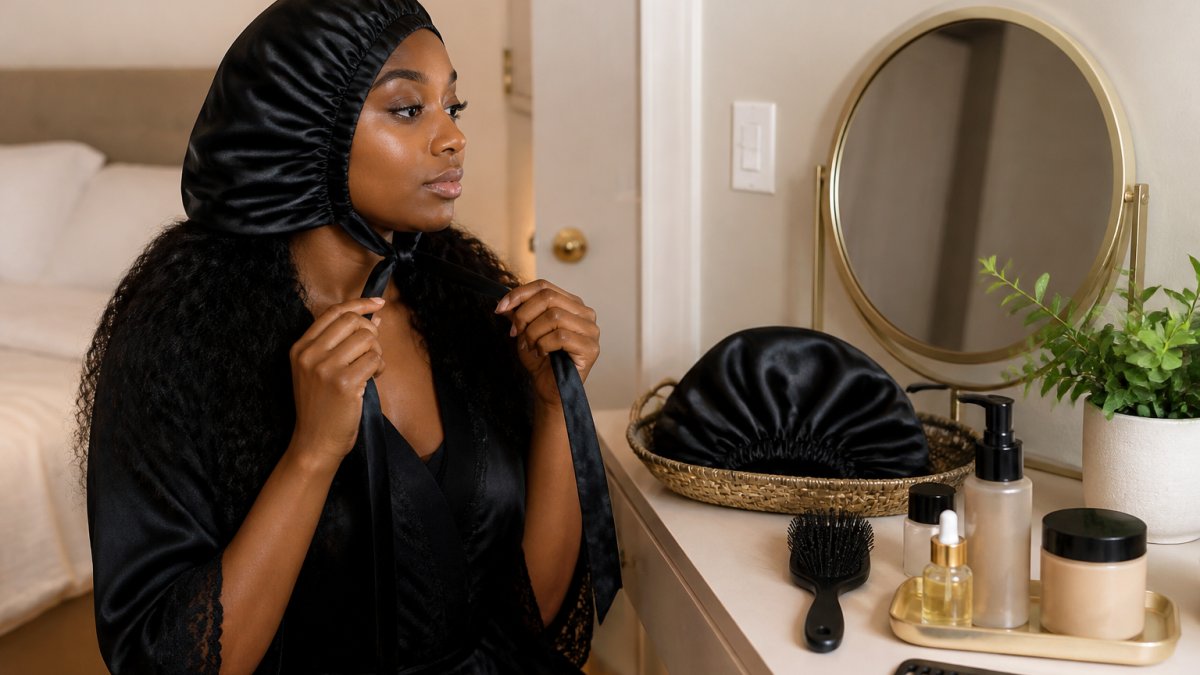
For short hair (chin length or above):
- Gather hair loosely toward the crown; do not twist tight.
- Place the bonnet over your head, front edge at the hairline.
- Pull the ties to the back and knot gently.
- Tuck any loose ends inside the band.
For medium hair:
- Gather hair into a loose, low pile on top of your head.
- Slide the bonnet on from front to back.
- Settle the band so it sits flat against your forehead.
- Tie once, then tuck the ends under the band.
For long or thick hair:
- Section hair into two loose coils and cross them at the crown.
- Lower the bonnet over the whole shape.
- Tie at the back, then bring the ties forward and knot again for security.
- Check that no strands pull at the temples.
For coily and textured hair:
- Preserve your existing set; do not re-part it.
- Use a bonnet with generous depth so curls are not compressed.
- Tie loosely; pressure flattens definition.
- Smooth the band flat so it does not crease your edges.
Fixing Fit Problems and Keeping the Wrap in Place
If your wrap slides off, the cause is almost always one of three things.
- Too much elastic tension. Elastic grips and slips. Ties hold.
- Too shallow a cap. Hair pushes the bonnet up and off.
- Too smooth a pillowcase. Silk on silk can slide; tie a little firmer.
A wrap that stays put should feel secure, not tight. If you feel pressure at your temples, loosen it.
Silk Hair Wrap vs Silk Pillowcase: Which Protects Better?
A silk pillowcase protects whatever touches it. A silk hair wrap protects all of your hair, all night.
| Feature | Silk Hair Wrap | Silk Pillowcase |
|---|---|---|
| Coverage | Full head, all night | Contact points only |
| Style retention | Holds curls and sets | Partial |
| Stays put | Yes, if tied well | N/A |
| Best for | Long, curly, styled hair | Short hair, skin benefits |
| Travel | Packs easily | Bulky |
They solve overlapping problems. If you have long or textured hair, the wrap does more. If your priority is skin and you have short hair, the pillowcase earns its place. Many people use both.
The Whispered Crown™ — Luxury Mulberry Silk Bonnet →
Mulberry Silk vs Satin for Hair: What the Label Doesn't Tell You
Mulberry silk is a fiber. Satin is a weave. Confusing the two is the biggest reason people buy the wrong product.
- Mulberry silk: Natural protein fiber from silkworms, breathable, temperature-regulating, hypoallergenic.
- Satin: A glossy weave that can be made from silk, polyester, or nylon.
- "Silk satin": Silk fiber woven in a satin structure. This is the good version.
Check the label for fiber content, not the product name. Look for a momme weight, which tells you fabric density.
Breathability matters for anyone dealing with night sweats. Silk regulates temperature better than polyester, which tends to trap heat.
How to Assess Silk Quality Before You Buy
Look for these, in order of usefulness:
- Fiber content on the tag: "100% mulberry silk" is the standard. "Silk-like," "satin finish," and "silky" are not fiber claims.
- Momme weight: Momme measures fabric density. Common ranges for sleepwear are roughly 16 to 25 momme; 19 to 22 momme is a common balance of durability and breathability. Very low momme feels thin and wears faster; very high momme feels heavier and less breathable.
- Grade: Silk is graded for fiber length and uniformity. Grade 6A is a common top grade cited by reputable sellers. Treat grade claims as a starting point, not proof.
A practical test when the product arrives: rub the fabric between your fingers. Silk warms quickly and feels smooth without a plastic slip. Polyester satin feels cooler at first and can have a faint synthetic sheen under direct light.
Weave and Momme: Why the Numbers Matter
Momme is the unit used for silk weight, roughly analogous to thread count for cotton. A 22-momme charmeuse is denser and more durable than a 16-momme fabric, which matters for a product you will wash repeatedly.
Weave affects surface smoothness. Charmeuse has a satin face on one side and a duller back on the other; the smooth face contacts your hair.
Care Guidance That Preserves the Silk
A silk bonnet should outlast a dozen cheap replacements. Care is the difference.
- Wash by hand in cool water with a pH-neutral silk wash. Hot water and alkaline detergents degrade silk fibers over time.
- Skip the dryer. Heat damages silk fibers and can shrink or distort the shape.
- Air dry flat, away from direct sun. Hanging wet silk can stretch it out of shape.
Hygiene deserves a mention. A bonnet sits against your scalp and hairline every night. Oils, sweat, and product build up.
Read the fiber tag, not the product title. "Satin" tells you how it was woven. "Mulberry silk" tells you what it is made of. Then check momme and construction, those are the numbers that predict how the wrap will perform and how long it will last.
For a complete nightly ritual, The Legacy Set™ pairs a mulberry silk robe with the bonnet, both in 22 momme silk.

The American Academy of Dermatology offers general guidance on scalp care that applies here: a clean, breathable surface against the skin is the baseline.
How to Care for a Silk Bonnet So It Lasts for Years
A silk bonnet should outlast a dozen cheap replacements. Care is the difference.
- Wash by hand in cool water with a pH-neutral silk wash.
- Skip the dryer. Heat damages silk fibers.
- Air dry flat, away from direct sun.
Hygiene deserves a mention. A bonnet sits against your scalp and hairline every night.
For a complete nightly ritual, The Legacy Set™ pairs a mulberry silk robe with the bonnet, both in 22 momme silk.
The American Academy of Dermatology offers general guidance on scalp care that applies here: a clean, breathable surface against the skin is the baseline.
Most people invest in good hair care and then hand eight hours a night back to cotton.
At Crowning Legacy by Ms. Our pieces use 100% Grade 6A mulberry silk at 22 momme, with extended silk ties for an adjustable fit that protects your edges instead of pressing on them.
Get started with Crowning Legacy by Ms. Carla and give your hair the overnight protection it has been missing.
Frequently Asked Questions
Is it good to sleep in a silk hair wrap every night?
Yes, for most hair types. A silk hair wrap reduces friction against your strands, helps lock in moisture, and protects styles while you sleep. The key is fit: choose a wrap with adjustable ties rather than tight elastic, so it stays in place without pulling your edges. Wash it every 7 to 10 wears to keep oils and product buildup from transferring back to your hair and scalp.
Do silk hair wraps actually work, or is it just marketing?
The mechanism is real: silk's smooth surface creates less friction than cotton, which is why users report less frizz and fewer broken strands in the morning. Be cautious with precise percentages you see online, including the widely repeated 43% less friction figure, since independent verification is limited. What you can control is quality: a 100% Grade 6A mulberry silk bonnet with double layers and adjustable ties performs differently from a satin blend.
Should you wear a silk bonnet or wrap with wet hair?
It is better to let hair dry to damp or fully dry first. Silk is breathable, but trapping soaking-wet hair for hours can leave strands smelling musty and weaken the fabric over time. If you must wrap damp hair, use a microfiber towel or cotton T-shirt for the first 20 to 30 minutes, then switch to your silk wrap for overnight protection. Apply leave-in products before wrapping so they absorb evenly.
How do you keep a silk hair wrap from slipping off while you sleep?
Look for a wrap with extended silk ties you can adjust, not a one-size elastic band. Tie the wrap snugly at the nape or under the chin, then tuck the ends in. If your hair is thick or coily, gather it loosely at the crown before tying so the fabric has something to grip. Side sleepers can also add a silk pillowcase underneath as a backup layer if the wrap shifts during the night.