


Last Updated: November 2, 2026
Quick Summary
Silk accessories protect hair extensions by reducing friction so strands glide instead of snagging, helping hold moisture in the hair shaft and preventing tangles at the nape and ends. Detangle, braid loosely, then cover with a silk bonnet or scarf to keep tension off attachment points overnight.
- Silk can reduce friction by up to 43% compared with polyester alternatives, per a Poshey beauty sleep journal report.
- Secure a loose braid with a silk scrunchie rather than a rubber band, which grabs and breaks strands.
- Choose genuine mulberry silk over polyester satin, which traps heat and can leave hair feeling dry.
- Wash your bonnet or scarf every one to two weeks if you wear it nightly.
- Line wool hats with silk or satin to limit daytime collar friction on extensions.
Table of Contents
- Why Silk Accessories Protect Hair Extensions Better Than Cotton
- How to Sleep with Hair Extensions Without Damaging Them
- Choosing a Silk Bonnet for Hair Extensions: Fit, Fabric, and Security
- How to Use a Silk Scarf for Hair Extensions: Wrapping and Tucking
- Silk vs. Satin for Hair Protection: What Actually Matters
- Matching Your Accessory to Your Extension Type and Attachment Method
- Caring for Your Silk Accessories So They Last
- Daytime Protection: Beyond the Bedroom
- Frequently Asked Questions
Why Silk Accessories Protect Hair Extensions Better Than Cotton
Silk accessories are a popular nighttime choice for keeping hair extensions smooth and moisturized. The reason comes down to surface friction. A Poshey beauty sleep journal report notes that silk can reduce friction by up to 43% compared with polyester alternatives. Cotton is rougher still. For the fuller evidence, see mulberry silk vs cotton for hair health.
Every time your hair rubs against a cotton pillowcase, the fibers catch on strands and pull. With natural hair, that means frizz. With extensions, it means something worse: tension at the attachment points.
Think about how much you move in your sleep. Your head turns, presses, and drags across that pillow for hours. Cotton grips. Silk glides.
Here is what silk can do that cotton typically cannot:
- Reduces friction so strands slide instead of snagging
- Helps hold moisture in the hair shaft
- Prevents tangles and matting at the nape and ends
- Limits pulling on the length overnight
- Cuts frizz and flyaways caused by rubbing
Our bonnets are made from 100% Grade 6A mulberry silk, a smooth surface that reduces overnight wear on your extensions.
How to Sleep with Hair Extensions Without Damaging Them
Learning how to sleep with hair extensions comes down to three steps: detangle, contain, and cover. Do them in that order every night and you prevent most of the damage that happens while you sleep.
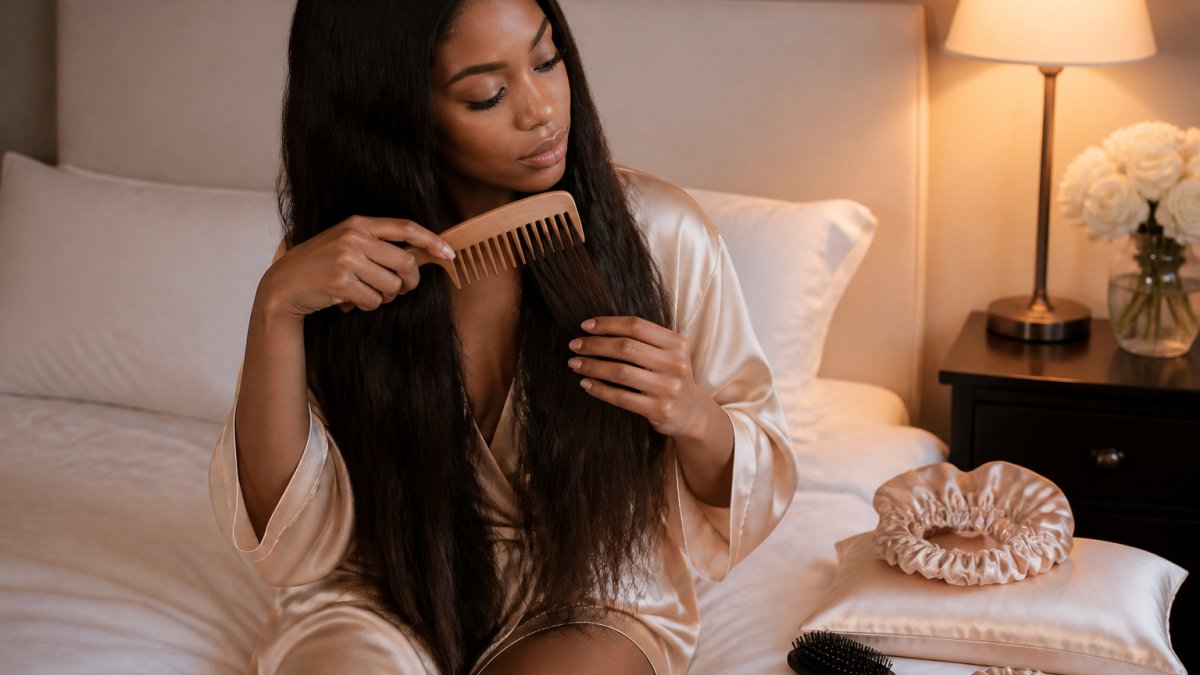
Step 1: Detangle and Section
Start at the ends and work upward with a wide-tooth comb. Never yank through a knot. Hold the mid-shaft so the pull never reaches your roots or attachment points. Work in small sections so you can feel tangles before they tighten.
Step 2: Braid Loosely and Secure
A loose braid keeps extension hair contained and reduces matting. Braid too tight and you create tension at the scalp. Secure the end with a silk scrunchie, not a rubber band. Rubber grabs and breaks strands.
Step 3: Cover with Silk
Slide on a silk bonnet or wrap with a silk scarf. This is the step that protects your work. The cover keeps the braid in place and stops friction against your bedding all night.
Choosing a Silk Bonnet for Hair Extensions: Fit, Fabric, and Security
Fit matters more than most shoppers realize. A bonnet that slips off by 2 a.m. protects nothing, and a bonnet that grips too tight pulls at your edges and attachment points. The right bonnet is roomy enough to hold a loose braid and long length, adjustable enough to stay put without elastic pressure, and made of a fabric that glides rather than grips.
Start with fabric. Look for genuine mulberry silk, not polyester satin. Silk is a natural fiber; satin is a weave that can be made from polyester, nylon, or silk. Our bonnet is double-layered for added coverage.
Then look at the closure. Adjustable silk ties let you set the fit yourself and are gentler than a tight elastic band, which can leave a mark across the forehead and pull at the hairline. If you prefer elastic, choose a soft, wide band rather than a thin tight one, and check that it does not press on your edges.
Match the size to your length. A bonnet sized for shoulder-length hair will not hold a long braid without pulling. If you have long extensions or bulky braids, choose a roomier cut or a bonnet with extra depth so the length sits inside rather than being compressed against the scalp. For step-by-step guidance, see how to choose the right size mulberry silk bonnet for long hair. Our Whispered Crown™ mulberry silk bonnet uses extended silk ties so you can set the fit yourself.

Test the fit before bed. Put the bonnet on, tuck your braid inside, and turn your head side to side. It should stay in place without a tight band across the forehead, and you should feel no pulling at the hairline or attachment line. If you feel pressure, loosen the ties; if it slips, tighten slightly or choose a roomier cut with a better closure. Watch out: a bonnet that feels secure when you put it on can creep up overnight if the ties are too loose, so check the fit after the first night and adjust.
Consider a scarf instead. If you have a lot of length or a bulky braid, a silk scarf gives you more control than a bonnet and lets you wrap the perimeter without compressing the roots. Many people keep both: a bonnet for short or medium lengths and a scarf for long extensions.
How to Use a Silk Scarf for Hair Extensions: Wrapping and Tucking
A silk scarf for hair extensions gives you more control than a bonnet, especially if you have a lot of length. The wrap-and-tuck method takes about a minute once you get the hang of it. For detailed overnight techniques, explore benefits of silk hair wraps for overnight protection.
- Lay the scarf flat and place the center at the back of your head
- Bring both ends forward over your ears
- Cross the ends at your forehead
- Wrap them back around and tuck the tails in securely
- Check that nothing pulls at your hairline
The goal is containment, not tension. Your wrap should feel snug but never tight.
Silk vs. Satin for Hair Protection: What Actually Matters
Silk and satin are not the same thing, and the difference matters for your extensions. Silk is a natural fiber made by silkworms. Satin is a weave, and it can be made from polyester, nylon, or silk. For a deeper comparison, read mulberry silk vs satin for hair.
The Whispered Crown™ — Luxury Mulberry Silk Bonnet →
Here is the practical breakdown:
| Feature | Mulberry Silk | Polyester Satin |
|---|---|---|
| Fiber source | Natural | Synthetic |
| Breathability | High | Low |
| Moisture handling | Holds moisture in hair | Can wick and dry hair |
| Friction | Very low | Low, but higher than silk |
| Heat retention | Regulates temperature | Traps heat |
Polyester satin looks shiny and costs less. But it traps heat and can leave hair feeling dry. For extensions you plan to keep for months, mulberry silk is the better investment.
Matching Your Accessory to Your Extension Type and Attachment Method
Most guides treat "hair extensions" as one category. They are not. A tape tab, a keratin bond, a sewn weft, and a clip-in each fail in a different way overnight, so the accessory and the wrap technique should change with the attachment method.
Clip-ins. These come out before bed, so the overnight job is protecting your natural hair and keeping the clips from bending or snagging. Remove the set, comb it out, and store it flat or on a hanger rather than coiled in a drawer where the clips can catch. Cover your natural hair with a bonnet or scarf as usual.
Tape-ins. The tape tabs are the weak point. Heat and sustained pressure soften adhesive, and a tight bonnet or a snug braid pulls directly on the tabs.
Sew-ins and weaves. The perimeter and the braided foundation carry the load. A silk scarf wrapped around the perimeter keeps the braid smooth and stops the weft from rubbing against the pillow, while a bonnet over the top contains the length. Keep the wrap off the actual cornrows, pressure there is what causes soreness and traction issues over weeks.
Lace fronts and closures. Lace is delicate and the hairline is sensitive. A bonnet with adjustable silk ties lets you set the fit so the lace is covered without being pressed. Avoid wraps that cross directly over the lace edge, and never sleep on a wet lace front, moisture plus pressure is a common route to lifting and shedding.
Keratin bonds and micro-links. Bonded and linked extensions are the most sensitive to tension and heat. Keep the cover loose, skip tight braids that pull at the bonds, and avoid anything that traps heat against the roots. A silk pillowcase alone can be enough on nights when a bonnet feels like too much pressure, and it removes friction without adding weight.
Wefts and halo pieces. These sit close to the head and can shift. A bonnet keeps them in place, and a silk scrunchie at the end of a loose braid stops the length from tangling without grabbing the weft.
The common mistake is treating every extension the same. Match the cover to how the hair is attached, keep the wrap loose over the attachment line, and you avoid the tension that causes the most expensive damage.
Caring for Your Silk Accessories So They Last
Silk lasts longer when washed gently. Hand washing is the gentler option for most silk pieces.
- Hand wash in cool water with a gentle detergent
- Skip the wringing; press water out with a towel
- Air dry away from direct sun and heat
- Store flat or loosely folded, not crushed
Wash your bonnet or scarf every one to two weeks if you wear it nightly. A clean silk surface protects better than a dusty one.
Daytime Protection: Beyond the Bedroom
Extensions take damage during the day too. Winter coats, scarves, and high collars rub against the nape and cause collar friction that leads to frizz and breakage.
A few daytime habits help:
- Line wool hats with silk or satin
- Loosen tight collars and scarves around your hair
- Pull long extension hair into a loose low style under coats
- Keep a silk scarf handy for windy days
Nighttime care does the heavy lifting. Daytime protection keeps the progress you made.
Your extensions are an investment, and the right silk accessories protect that investment night after night. At Crowning Legacy by Ms. Carla, our bonnets and robes are crafted from 100% Grade 6A mulberry silk, with double-layer bonnets and adjustable silk ties. Explore The Legacy Set™ for a complete silk ritual of rest. Get started with Crowning Legacy by Ms. Carla and give your hair the softness and protection it deserves.
Frequently Asked Questions
What protects hair better, silk or satin?
Silk is a natural protein fiber, while satin is a weave structure that can be made from silk, polyester, or other fibers. Both create a smooth surface that reduces friction. For hair extensions, the key is a smooth, non-absorbent surface. Silk accessories made from mulberry silk give you the friction reduction of satin plus natural breathability.
Do silk bonnets help with extensions?
Yes. A silk bonnet for hair extensions keeps the hair contained and reduces friction against bedding and clothing. This helps prevent tangles, matting, and breakage at attachment points. Look for a bonnet with adjustable ties rather than tight elastic, which can create tension and leave marks. The bonnet should cover the hair completely without pulling on edges or the nape.
Should you wear a silk bonnet or use a silk pillowcase with hair extensions?
Both protect hair, but they work differently. A silk pillowcase protects any hair that touches the pillow, which is helpful if you move around a lot. A silk bonnet contains all your hair, including ends that may hang off the pillow. For extensions, a bonnet offers more complete protection because it keeps the hair gathered and covered. Many people use both for maximum protection.
How should you prepare hair extensions before bed?
Detangle gently with a wide-tooth comb or loop brush, starting from the ends and working up. Braid the hair loosely to prevent tangling, then cover with a silk bonnet or scarf. Avoid tight braids or elastics that pull on attachment points. If your extensions are taped or bonded, keep the braid low and loose to avoid stress on the bonds.
