


Table of Contents
- Why Your Silk Bonnet Keeps Slipping Off
- How to Choose the Right Bonnet Size for Your Hair
- Step-by-Step: How to Keep Your Silk Bonnet On All Night
- How to Protect Curls at Night Beyond the Bonnet
- Best Silk Bonnet for Restless Sleepers
- Bonnet Alternatives When Nothing Else Stays Put
- How to Keep Your Silk Bonnet Clean and Long-Lasting
- Conclusion
Last Updated: August 16, 2026
Why Your Silk Bonnet Keeps Slipping Off
Waking up to find your silk bonnet on the pillow instead of your head undoes your entire nighttime routine. At Crowning Legacy by Ms. Carla, we hear this constantly, and the good news is that slippage almost always comes down to one of two fixable problems: a bonnet on a head that isn't properly prepared, or a bonnet that doesn't fit your hair's actual volume and density.

Elastic Band Wear and Slippage
The elastic band is the first thing to fail on any bonnet. With regular washing and nightly stretching, elastic loses tension over time. Check the band by stretching it between your fingers. If it snaps back with strong resistance, it still has life. If it feels limp or takes a moment to return to shape, the bonnet is past its functional prime. Quality matters significantly, bonnets with durable elastic or an adjustable drawstring will outlast cheaper alternatives by a considerable margin.
Hair Volume and Density Mismatches
A bonnet sized for fine, relaxed hair will not stay on thick, coily hair. More volume means more upward pressure against the bonnet, and a band that isn't wide or strong enough will ride up and off during the night. Hair density is not the same as hair length; two women with shoulder-length hair can have completely different bonnet needs depending on texture and volume.
According to American Academy of Dermatology guidance on hair care, protective nighttime coverings reduce friction-related hair breakage significantly, but only when they fit correctly. A bonnet that slips off provides no protection at all.
How to Choose the Right Bonnet Size for Your Hair
The right fit accounts for hair density, hair length, and your sleeping style. A bonnet that fits correctly at the hairline, sits comfortably at the nape of the neck, and doesn't constrict the scalp is the foundation of overnight curl preservation.
Measuring for Fit Based on Hair Density
Start with a soft measuring tape around your head at the hairline, then add volume allowance based on your hair density:
- Fine or low-density hair: Add roughly 1-2 inches to your circumference measurement
- Medium-density hair: Add 2-3 inches
- High-density or thick coily hair: Add 3-5 inches or more
The bonnet should slip on without pulling and sit at your natural hairline without digging in. Hair length matters too, longer hair creates more bulk at the crown, which pushes against the top of the bonnet.
Adjustable Strap vs. Fixed Elastic: Which Holds Better
Adjustable straps win. Fixed elastic bands are manufactured to a standard tension that may not match your hair's volume on any given night. A drawstring or adjustable strap lets you dial in the exact tension you need each night, accounting for variation between wash day and stretched-out second-day hair.
| Feature | Fixed Elastic | Adjustable Drawstring |
|---|---|---|
| Fit customization | None | High, cinch to exact tension |
| Best for hair density | Fine to medium | All densities, especially thick |
| Longevity | Degrades with washing | Maintains fit over time |
| Restless sleepers | Often slips | Stays secure with proper cinch |
| Hair volume variation | Cannot adapt | Adjusts nightly |
Step-by-Step: How to Keep Your Silk Bonnet On All Night
Keeping a silk bonnet on all night is a technique, not just a product decision. The right bonnet applied incorrectly will still slip. Follow these steps consistently and slippage becomes rare.
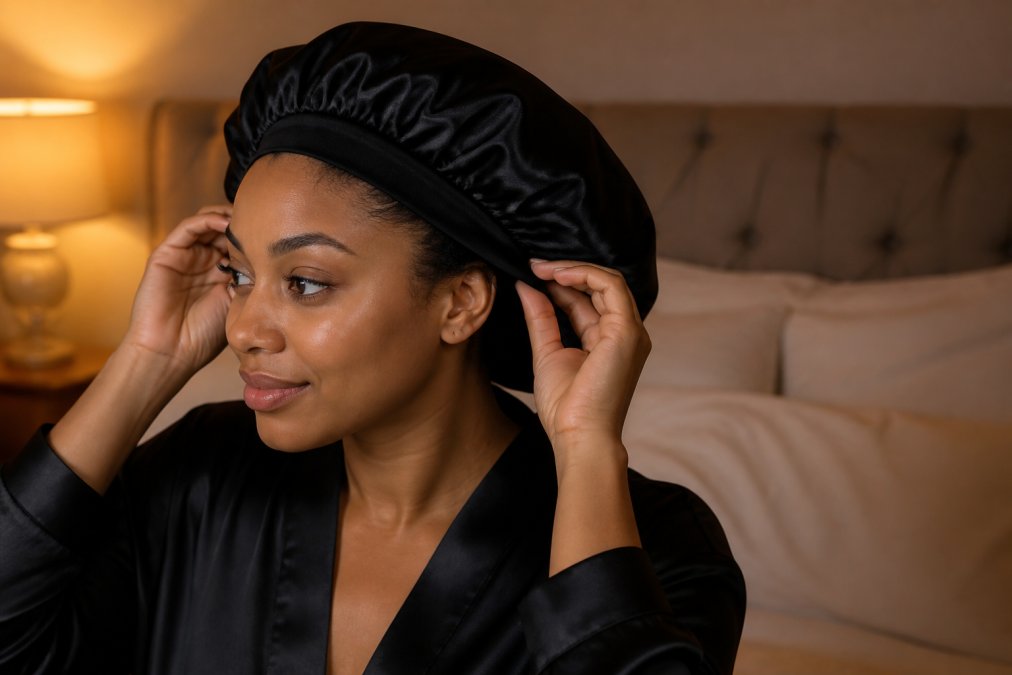
Step 1, Prep Your Hair Before Bed
Hair that is completely dry and lightly moisturized sits more compactly inside a bonnet than damp, freshly washed hair. If you wash your hair at night, give it time to air dry or diffuse before putting on your bonnet. Apply a light leave-in or sealing oil to smooth the cuticle and reduce friction. For high-volume styles, gather your hair gently before placing the bonnet rather than piling it straight up.
Step 2, Position the Bonnet Correctly at the Hairline
Start at the nape of the neck, not the top of the head. Hold the bonnet open with both hands, tilt your chin slightly toward your chest, and place the back edge at the nape first. Roll the bonnet forward and upward over the crown, then bring the front edge down to sit just at or slightly behind your natural hairline. This placement protects edges from pillowcase friction.
Step 3, Secure the Nape of the Neck
The nape of the neck is where most bonnets lose their grip first. After positioning the bonnet, press the band firmly against the nape and hold for a moment. If your bonnet has a drawstring, pull it gently to close the gap. The band should sit flat against the skin without cutting in.
Step 4, Use Bobby Pins for Extra Hold
Bobby pins are the backup plan that actually works. After securing your bonnet, slide two or three bobby pins through the band and into the hair just above the nape and at the temples. Use flat, smooth bobby pins rather than ridged ones to avoid snagging the silk. Place them horizontally through the band so they grip a wider section of hair.
How to Protect Curls at Night Beyond the Bonnet
A silk bonnet on its own is a strong foundation for overnight curl preservation, but pairing it with complementary techniques creates a more complete system. According to National Institutes of Health research on hair fiber structure and damage, friction against rough surfaces is a primary mechanical cause of hair breakage and cuticle damage.
The Pineapple Method for High-Volume Styles
Gather your hair loosely at the very top of the head and secure it with a soft scrunchie or loose hair tie. When you place the bonnet over a pineapple, the hair sits at the crown of the bonnet rather than being pressed down against your scalp, preserving curl definition and volume overnight. This method works best for hair that is at least chin length.
Satin Pillowcase as a Backup Layer
Even a perfectly positioned bonnet will occasionally come off during sleep. A satin or silk pillowcase is your second line of defense. For restless sleepers who move frequently, the combination of a well-fitted bonnet and a satin pillowcase provides near-complete overnight hair protection.
Best Silk Bonnet for Restless Sleepers
The best silk bonnet for restless sleepers is one built with an adjustable closure, a generous interior, and true mulberry silk, not a satin blend marketed as silk.
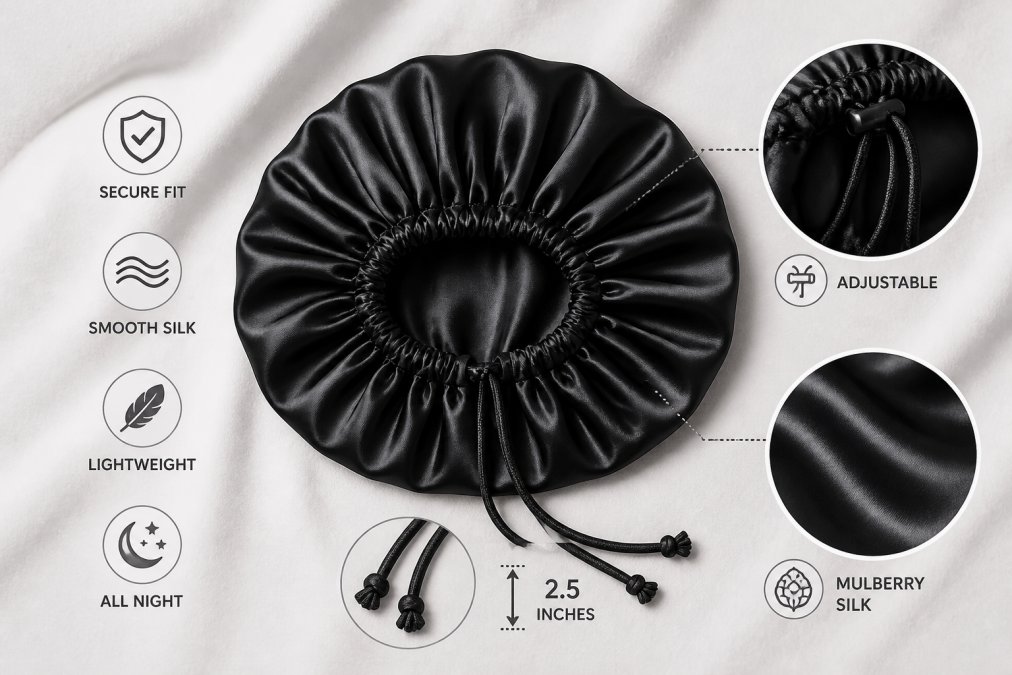
The Whispered Crown™ by Crowning Legacy by Ms. Carla is designed precisely for this. Crafted from luxury mulberry silk and built with generational care, it offers the adjustable fit that restless sleepers need. The drawstring closure allows you to cinch the bonnet to your exact hair volume each night. Mulberry silk matters because its smooth protein fiber structure creates minimal friction against the hair shaft, making it genuinely protective. The Whispered Crown™, Onyx Reign is available at $95.00.
Bonnet Alternatives When Nothing Else Stays Put
Some nights, even a well-fitted bonnet won't cooperate. Restless sleepers or women whose hair volume makes any band uncomfortable need alternatives that still deliver overnight hair protection.
Satin-lined sleep cap: A deeper, helmet-style cap with a wider band distributes pressure more evenly and accommodates more hair volume without upward pressure.
Satin scarf wrap: A large satin or silk scarf can be wrapped and tied at the hairline, then tucked at the nape. The tie creates a custom fit that no elastic band can replicate.
Silk pillowcase only: For hair that is too short or too fine to benefit from a bonnet, a 100% mulberry silk pillowcase provides friction reduction without any covering.
Bonnet with a headband overlay: Place a wide, soft fabric headband over the bonnet band after putting it on. This adds a second layer of grip and distributes holding force across a wider area.
According to Trichological Society guidance on protective styling and hair retention, the consistency of a nighttime protective routine matters more than any single product choice.
How to Keep Your Silk Bonnet Clean and Long-Lasting
A silk bonnet that isn't properly maintained will lose its protective qualities faster than it should. Wash your bonnet every one to two weeks, or more frequently if you apply heavy products to your hair before bed.
Washing method:
- Fill a basin with cool water and add a small amount of gentle, pH-neutral detergent
- Submerge the bonnet and gently agitate for 30-60 seconds
- Squeeze water out gently; do not wring or twist
- Rinse thoroughly in cool water until no soap remains
- Lay flat on a clean towel and roll to press out excess moisture
- Air dry flat or hang loosely; never use heat
Store your bonnet flat or loosely folded in a breathable pouch, not compressed in a drawer. If your bonnet has a fixed elastic band, avoid stretching it more than necessary when putting it on.
Keeping curls protected overnight is a discipline that rewards consistency. The common frustration of waking up to a bonnet on the pillow comes down to fit, technique, and maintenance, all three are solvable. For women who want a bonnet that holds through the night, accommodates real hair density, and is built to last, the Whispered Crown™ by Crowning Legacy by Ms. Carla offers luxury mulberry silk construction with an adjustable drawstring closure designed for exactly this purpose. Add it to your nighttime routine and wake up to preserved curls, protected edges, and the kind of morning that starts with intention.
Frequently Asked Questions
Why does my silk bonnet fall off when I sleep?
The most common causes are a worn-out elastic band that has lost its grip, a bonnet that is too large for your head circumference, or a hair volume that stretches the cap past its capacity. Restless sleepers face extra slippage because movement works the bonnet off the hairline gradually. Switching to a bonnet with an adjustable drawstring or strap, sizing down, and securing the nape of the neck with a flat bobby pin before bed resolves most slippage issues.
Should a silk bonnet be tight or loose?
A properly fitted silk bonnet should feel snug at the hairline without digging into the scalp or leaving marks. If you can slip two fingers under the elastic comfortably, the fit is close to right. Too loose and it slides off; too tight and it disrupts scalp comfort and can stress the hairline over time. Women with thick, high-density hair often need a larger bonnet or one with an adjustable strap to accommodate full volume without feeling constricted.
How do I keep my bonnet on all night if I toss and turn?
Start with a bonnet sized for your hair density and volume. Position it from the front hairline back, pulling it firmly over the nape of the neck. Secure each side with a flat bobby pin angled downward. Pairing the bonnet with a satin-lined pillowcase adds a second layer of friction reduction, so even if the bonnet shifts slightly, your curls stay protected from hair breakage and tangles caused by cotton pillowcase friction.
How do I protect my curls at night without a bonnet?
The pineapple method works well for longer curl patterns: gather hair loosely at the crown with a soft scrunchie to preserve curl shape and reduce tangle formation. A satin-lined pillowcase alone reduces friction significantly compared to cotton. For shorter or tighter textures, a satin scarf tied securely at the nape of the neck offers more coverage and hold than a standard bonnet for restless sleepers who find bonnets impractical.
This article was written using GrandRanker