


Last Updated: October 27, 2026
Quick Summary
Silk pajamas can be worth it for hormonal skin changes if friction and night-time comfort are your main concerns, since mulberry silk has very low surface friction. The article notes that the evidence for silk treating those changes is limited, and that silk costs more and needs careful hand washing than cotton or modal alternatives.
- Mulberry silk has the lowest surface friction of the fabrics compared, which matters for reactive skin.
- Silk costs the most and needs hand washing in cool water with pH-neutral detergent.
- Cotton, bamboo viscose, and modal are simpler, cheaper alternatives.
- Check fiber content and weave on labels, since satin can be polyester rather than silk.
- Look for Grade 6A mulberry silk and the momme weight before buying.
Table of Contents
- What Hormonal Skin Changes Do to Your Skin at Night
- Silk Pajamas for Menopause: What the Evidence Supports
- Silk Pajamas for Hot Flashes and Night Sweats
- Silk vs Satin Pajamas: How the Fabrics Compare
- Mulberry Silk Grade, Momme Weight and Construction
- Care, Durability and Cost per Wear
- Choosing Your Silk Sleepwear for Hormonal Skin Changes
- Frequently Asked Questions
What Hormonal Skin Changes Do to Your Skin at Night
Hormonal shifts change how your skin behaves, and they often show up most clearly overnight. Skin can feel drier, more reactive, and slower to recover during perimenopause, menopause, pregnancy, and the days around a menstrual cycle.
Hormonal skin changes are shifts in skin hydration, sensitivity, and texture that occur as estrogen and other hormone levels rise and fall. These changes can make skin feel tight in the morning, more prone to sleep creases, and quicker to irritate from friction.
Nighttime is when friction does the most damage. You move against your pillowcase for hours, and that contact can tug at fragile skin. Many people also run warm during the night, which adds sweat and makes the surface feel less comfortable. A few common patterns show up:
- Dryness that lingers into the morning
- Redness or irritation after a rough night
- Sleep creases that take longer to fade
- Sensitivity to fabrics that once felt fine
Watch out: Don't assume every new irritation is harmless. If a rash, persistent redness, or sudden change in skin feels unusual, a dermatologist or your doctor should evaluate it.
Silk Pajamas for Menopause: What the Evidence Supports
Menopause brings a well-documented set of skin changes, and interest in fabric choices has grown alongside them. A Galderma survey on menopause-related skin changes reports that more than half of women first learned about these effects by experiencing them personally Galderma menopause-related skin changes survey. That finding points to a real awareness gap, but it does not show that silk sleepwear treats those changes.
Claims with a plausible mechanism.
Claims that outrun the evidence.
Market interest is real, though. A Grand View Research report projects continued growth in menopause skin care products through 2033 Grand View Research menopause skin care market report. Growing demand is a reason to look closely at what you are buying, not a reason to assume the benefits are proven.
Silk Pajamas for Hot Flashes and Night Sweats
The Royal Wrap™ robe from Crowning Legacy by Ms. Carla is made from 100% Grade 6A mulberry silk at 22 momme. You can also read our guide on benefits of silk for perimenopause night sweats for more context.
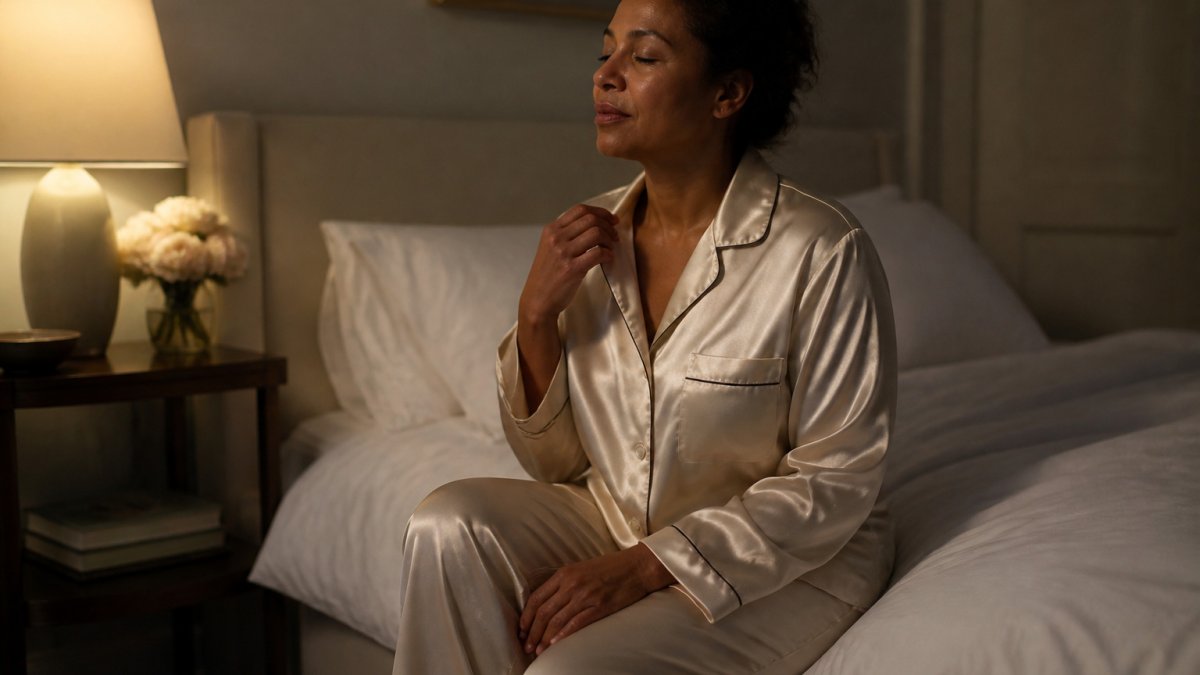
When you shop for night sweat sleepwear, look for:
- Breathable fabric that doesn't trap heat
- A relaxed cut that doesn't press against the body
- Easy-care construction so you can wash it often
Silk vs Satin Pajamas: How the Fabrics Compare
Silk and satin get confused because both have a smooth, glossy surface, but they are not the same thing. Silk is a natural protein fiber produced by silkworms (the NIH). Satin is a weave structure, and it can be made from silk, polyester, nylon, or blends. A satin pajama set is often polyester, which changes how it breathes, how it feels against reactive skin, and how it holds up in the wash.
For hormonal skin changes, the useful comparison is not just silk versus satin. It is mulberry silk versus the other fabrics people actually sleep in: cotton, bamboo viscose, modal, and synthetic satin. Each has a different fiber source, weave, breathability profile, friction level, care requirement, and cost.
| Feature | Mulberry Silk | Cotton | Bamboo Viscose | Modal | Synthetic Satin |
|---|---|---|---|---|---|
| Fiber source | Natural protein fiber from silkworms | Natural cellulose fiber from cotton plant | Regenerated cellulose from bamboo pulp | Regenerated cellulose from beech pulp | Usually polyester or nylon |
| Typical weave for sleepwear | Charmeuse or crepe de chine | Plain weave, jersey, or flannel | Jersey or woven | Jersey or woven | Satin weave |
| Breathability | High; lightweight grades move air well | Moderate to high depending on weave | High | High | Generally lower; traps heat |
| Surface friction | Very low; smooth filament surface | Moderate; depends on yarn and finish | Low to moderate | Low to moderate | Low against skin but can cling when warm |
| Moisture feel | Absorbs some moisture while feeling dry against skin | Absorbs moisture and can feel damp | Absorbs moisture well | Absorbs moisture well | Poor moisture handling; can feel clammy |
| Care | Gentle hand wash or delicate cycle, pH-neutral detergent, air dry | Machine wash and dry | Machine wash cool, air dry to prevent shrinkage | Machine wash cool, low dry | Machine wash, but pills and snags over time |
| Relative cost | Highest | Lowest | Low to moderate | Moderate | Low |
A few practical notes on that table. Cotton is the easiest to care for and the cheapest, but standard cotton sleepwear has more surface friction than silk, and heavy flannel can trap heat during night sweats. Bamboo viscose and modal are soft and breathable, and they absorb moisture well, but they are regenerated cellulose rather than natural protein fibers, and they can stretch or pill with repeated washing. Synthetic satin looks similar to silk and costs far less, but polyester does not breathe the way silk does, and it can feel clammy once sweat builds up.
The Royal Wrap™ — Luxury Mulberry Silk Robe →
Silk sits at the high end on cost and care, and at the low end on friction. That combination is why it shows up so often in conversations about sensitive or reactive skin. The tradeoff is real: you pay more upfront and you wash more carefully. If budget or easy care is the priority, cotton, bamboo, and modal are reasonable alternatives, and none of them carry the same washing requirements as silk.
When you compare labels, check the fiber content first, then the weave. A "satin pajama" can be 100% polyester, 100% silk, or a blend, and the fiber content tells you more about breathability and friction than the word satin does.
Mulberry Silk Grade, Momme Weight and Construction
Not all silk is the same, and the label details matter more than marketing language. Two terms are worth understanding before you buy.
Momme (pronounced "mom") is the unit used to measure silk weight. Higher momme generally means denser, heavier fabric. Many sleepwear pieces fall in the 19 to 22 momme range, and Crowning Legacy by Ms. Carla's Royal Wrap™ is 22 momme, which sits toward the richer end of that range.
Grade refers to fiber quality. Grade 6A is the highest commonly described grade for mulberry silk, meaning longer, more even fibers with fewer defects. Ask any seller to confirm the grade, and be cautious of listings that describe silk only with vague terms like "premium."
Construction also affects comfort. Double-layer bonnets and robes with lined seams can feel more substantial, while lighter constructions breathe more. Choose based on whether you run hot or prefer a little more coverage.
A common mistake is buying on price alone and ending up with a fabric that pills, thins, or feels slick in the wrong way. Check the momme weight, grade, and fabric description before you add anything to your cart.
Care, Durability and Cost per Wear
Silk rewards careful care, and cost per wear is the best way to judge whether it's worth the price. A $280.00 robe worn every night for two years works out very differently from the same robe worn twice a month.
To make silk last:
- Hand wash in cool water with a pH-neutral detergent
- Avoid wringing; press water out gently with a towel
- Dry flat or on a hanger away from direct sun
- Store folded or hung so the fabric doesn't crease
For cost per wear, divide the purchase price by the number of times you realistically wear the piece. Our Royal Wrap™ and the Legacy Set™ ($333.00, bundling the robe with the Whispered Crown™ bonnet) are priced for buyers who plan to keep and wear them regularly. If you'd rather start smaller, the robe alone is the simpler entry point. Read our guide on how to wash silk robes without damage before your first wash, since that step matters most for longevity.

Choosing Your Silk Sleepwear for Hormonal Skin Changes
Browse the Royal Wrap™ robe and the Legacy Set™ to see which option fits your routine.
Frequently Asked Questions
Are silk pajamas hot to sleep in?
Mulberry silk is a breathable natural fiber that tends to feel cooler against the skin than many synthetic fabrics, and it wicks moisture away from the body. For most sleepers it feels comfortable in warm rooms, but it does not actively cool you the way a fan or cooling mattress would. Heavier momme weights hold more heat, so a lighter-weight set may suit warm nights better. Layering a light cotton or breathable top under a silk robe is another option if you run hot.
What is the difference between 100% silk and mulberry silk?
Mulberry silk is silk produced by silkworms fed only on mulberry leaves, and it is the most common type used in sleepwear. Silk labeled simply as 100% silk can come from other silkworm species, such as tussah silk, which has a coarser texture and a more irregular surface. For sleepwear that feels smooth against sensitive skin, look for 100% mulberry silk, and check the grade, such as Grade 6A, and the momme weight on the label.
How should you wash mulberry silk pajamas?
Hand wash mulberry silk in cool water with a pH-neutral, silk-safe detergent, and avoid wringing or twisting the fabric. Use a soft press-and-release motion, rinse thoroughly, and lay the pieces flat on a towel to dry out of direct sunlight. Silk can also be machine washed on a gentle cycle inside a mesh laundry bag, but hand washing usually preserves the surface finish longer. Avoid fabric softeners, which can coat the fibers and reduce breathability.
Can mulberry silk sleepwear help with skin sensitivity during hormonal changes?
Silk has a smooth surface that produces less friction than cotton or many synthetic fabrics, which may reduce irritation for some people with sensitive skin. Its natural protein structure can also help the fabric absorb less moisture from the skin than cotton does. However, the research on silk and specific hormonal skin conditions is limited, and silk will not treat dryness, rashes or inflammation on its own. If skin symptoms persist or worsen, a dermatologist or healthcare provider should assess them.
