


Last Updated: November 4, 2026
Quick Summary
Silk bonnets protect delicate newborn hair from friction during handling and add a soft, timeless quality that synthetic props cannot match. Mulberry silk is a natural protein fiber with a smooth surface, so it is gentle on thin, reactive newborn scalps. Use a bonnet only as a supervised photography prop, never for sleep.
- Satin describes a weave while silk describes a fiber, so check the label's fiber content.
- Keep headwear on for only brief periods per setup, then remove it before the next look.
- The tie should be loose enough to slip two fingers underneath at the forehead.
- Skip the bonnet if the baby is congested, has a fever, or has a scalp rash.
- Look for 100% mulberry silk with a listed momme weight and adjustable ties, not elastic.
Table of Contents
- Why Silk Bonnets Are Changing Newborn Portraits
- The Benefits of Silk for Newborn Skin and Hair
- Silk vs. Satin for Baby Hair Health
- Safety First: How to Use Bonnets in a Photo Session
- Heirloom Newborn Photography Props That Last
- Styling Tips for Photographers and Parents
- What to Look For in a Newborn Silk Bonnet
- Choosing Your Heirloom Bonnet for the Session and Beyond
- Frequently Asked Questions
Why Silk Bonnets Are Changing Newborn Portraits
Silk bonnets for newborn photography solve two problems at once: they protect delicate newborn hair from friction during handling, and they add a soft, timeless quality that synthetic props cannot match. Parents and photographers increasingly plan bonnets into newborn sessions rather than treating them as an afterthought.
The reason is simple. According to guidance on infant hair and scalp care from the American Academy of Pediatrics, newborn hair and scalp are especially fragile in the first months, which makes the choice of fabric against the head worth thinking through.
Below, we break down what silk actually does for newborn skin and hair, how it differs from satin, how to use a bonnet safely during a session, and what to look for before you buy.
The Benefits of Silk for Newborn Skin and Hair
Silk is a natural protein fiber with a smooth surface. For a newborn, that combination is worth considering.
Moisture Retention and Friction Reduction
Rough fabric against a newborn's scalp can add friction every time the head is turned or lifted, while a smooth surface lets hair move more freely.
Gentle on Sensitive Scalps and Cradle Cap
A newborn's scalp is thin and reactive. Silk's smooth finish is gentler than rougher fabrics when it touches the scalp. If your baby has cradle cap, a bonnet should only be worn briefly and loosely, and never for sleep. For parents who want reassurance about material safety, our article on whether mulberry silk is hypoallergenic for sensitive skin explains why mulberry silk is generally well tolerated.
Silk vs. Satin for Baby Hair Health
The short answer: satin describes a weave, while silk describes a fiber. A mulberry silk bonnet is made from a natural protein fiber.
| Feature | Mulberry Silk | Polyester Satin |
|---|---|---|
| Fiber source | Natural protein fiber | Synthetic |
| Breathability | High | Low, traps heat |
| Static buildup | Minimal | Noticeable |
| Moisture handling | Gentle, absorbent | Repels moisture |
| Feel against scalp | Soft, cool | Smooth but slick |
"Satin" on a label tells you nothing about fiber content, so check what the fabric is made of, not just the finish. For the fuller comparison, our breakdown of mulberry silk vs. satin for skin covers the difference in depth.
Safety First: How to Use Bonnets in a Photo Session
Silk bonnets are a photography prop, not sleepwear. Head coverings are generally not recommended for infants during sleep. Use a bonnet only while a newborn is awake, supervised, and positioned for the shot.
The Photographer's Safety Protocol
A bonnet session should follow a sequence, not an improvisation. A safe session follows a clear sequence:
- Set the shot before the bonnet goes on. Pose the baby, arrange the blanket, and lock your camera settings first. The bonnet is the last element added and the first removed.
- Assign one pair of hands to the head. During any bonnet shot, one adult supports the head and neck while a second adjusts ties or frames the image. Never tie a bonnet one-handed while the baby is unsupported.
- Cap wear time. Keep headwear on for only brief periods per setup, then remove it before the next look.
- Check the fit with two fingers. The tie should be loose enough to slip two fingers underneath at the forehead. If the silk leaves a visible indentation when removed, it was too tight.
- Watch the chest and face, not just the bonnet. A newborn who is overheating will flush, sweat at the hairline, or grow fussy. Remove the bonnet at the first sign and cool the room if needed.
- Never cover the eyes, nose, or mouth. The bonnet should sit behind the hairline, not on the brow. If the tie ends drift toward the face, tuck them behind the shoulders.
Supervision and Session Duration
The bonnet should appear in short windows within that schedule, not stay on for the full session. Keep the baby in direct line of sight whenever the bonnet is on, and never leave the room or step back to change a lens while a bonnet is tied. If the baby drifts into a deep sleep during a bonnet setup, remove the bonnet before continuing the pose.
Watch out: a bonnet tied snugly can leave marks on a newborn's forehead. If a mark persists after removal, loosen the tie.
Breathability and Fabric Checks
Breathability is helpful, but it is not a substitute for supervision.
When to Skip the Bonnet Entirely
Some babies should not wear a bonnet at all. Skip it if the newborn is congested, has a fever, is recovering from a cold, or is unusually fussy and hard to settle. Skip it if the baby has a scalp rash, active cradle cap with broken skin, or a recent vaccination site near the head. And skip it if the parents are uncomfortable; a parent's hesitation is reason enough to move to a bonnet-free setup. A skilled photographer can build a beautiful frame with a wrap, a blanket, or bare hair.
The Whispered Crown™ — Luxury Mulberry Silk Bonnet →
Heirloom Newborn Photography Props That Last
The best props do double duty: they carry the portrait and then go home with the family as a keepsake. A bonnet in a neutral tone, like deep onyx or soft bone, photographs cleanly against cream and ivory blankets and holds up as a small heirloom long after the session ends.
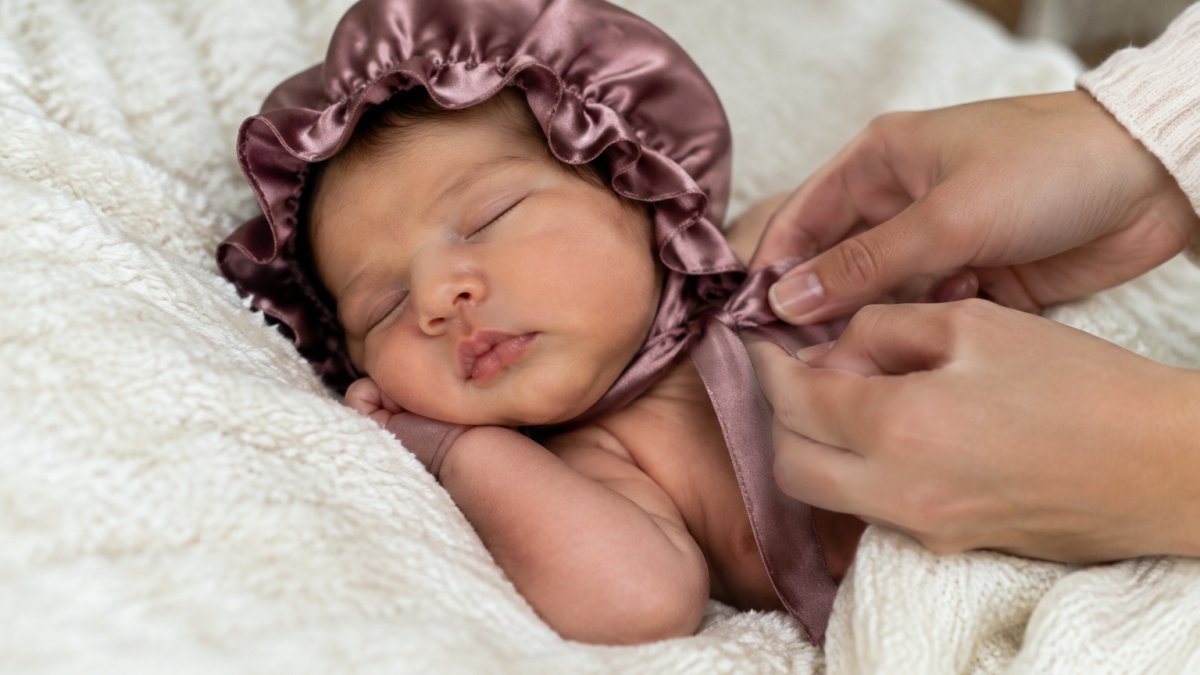
Photographers who build a prop collection tend to choose pieces that will not pill or yellow after a few uses. If you are shopping for a new mother beyond the shoot, our guide to luxury heirloom gifts for new mothers covers pieces that last.
Styling Tips for Photographers and Parents
Styling a bonnet well comes down to proportion, placement, and light. A bonnet that sits too far forward crowds the face; one that sits too far back looks like it is falling off. The difference between an heirloom and a costume is usually a matter of an inch and a stop of exposure.
Placement and Face Framing
The bonnet's front edge should sit just behind the hairline, roughly a finger's width back from the brow. That keeps the face fully visible and lets the silk catch light along the crown rather than casting a shadow across the eyes. For a three-quarter profile, rotate the bonnet slightly so the tie falls on the far side of the face; this opens the near cheek and keeps the tie from cutting across the jawline. For a top-down shot, pull the bonnet back another half inch so the forehead and brows remain the focal point.
Proportion and Headwear Stacking
A newborn's head is large relative to the body, so a bonnet that looks small in hand can look oversized on the baby. Match the bonnet's visual weight to the pose: long ties suit a wrapped, swaddled pose, while a close-fitting bonnet suits a bare-shouldered setup. Skip layering a bonnet over a thick knit cap; the bonnet works best directly against the hair, and a second layer adds bulk that distorts the silhouette.
Color, Tone, and Lighting
Match the bonnet tone to the blanket, not the outfit, for a softer frame. A deep onyx or soft bone bonnet against cream and ivory blankets keeps the eye on the face, while a bonnet that matches a bright outfit competes with the skin tone. Under studio strobes, silk's sheen can produce a hot highlight on the crown; angle the key light slightly off-axis or feather it to keep the sheen soft. Under window light, position the baby so the silk catches the light at a low angle, which reads as a gentle glow rather than glare. Warm undertones tend to flatter most newborn skin, while cool grays can wash out a ruddy complexion.
Tie Styling and Negative Space
Let the tie ends fall naturally rather than knotting them tightly. A loose, draped tie adds a vertical line that draws the eye down the frame and gives the portrait a sense of movement. If the tie ends are long, curl them gently rather than folding them into a hard angle. Leave negative space around the bonnet; a tight crop can make the head look oversized, while a little breathing room restores proportion.
A Quick Styling Checklist for the Session
- Place the bonnet last, after the pose and the light are set
- Sit the front edge a finger's width behind the hairline
- Rotate the bonnet for three-quarter and profile shots so the tie falls on the far side
- Match the bonnet tone to the blanket, not the outfit
- Feather the key light to soften the silk's sheen
- Leave negative space around the bonnet in the frame
- Skip the knit cap underneath; one layer is enough
Watch out: a bonnet photographed straight-on with a hard key light will show every fold and crease in the silk. If the fabric looks wrinkled in the frame, steam it briefly before the session rather than fixing it in post.
What to Look For in a Newborn Silk Bonnet
Look for three things: the fiber, the fit, and the finish. Check that the label says 100% mulberry silk, ideally with a momme weight listed, since momme measures silk density and heavier weights feel more substantial. Confirm the bonnet uses adjustable ties rather than elastic, which can create tension around a newborn's head. Finally, inspect the seams; flat, enclosed seams are gentler against skin.
A quick buying framework:
- Fiber: 100% mulberry silk, not "satin" alone
- Weight: a listed momme weight signals real quality control
- Fit: adjustable ties, no elastic band
- Seams: enclosed and flat
- Care: washable without losing sheen
Choosing Your Heirloom Bonnet for the Session and Beyond
A bonnet that photographs beautifully and then goes home to be worn, kept, and eventually passed down is a different purchase than a disposable prop. That is the standard we build to at Crowning Legacy by Ms. Carla. The Whispered Crown™ is made from double-layer Grade 6A mulberry silk at 22 momme, with extended silk ties that adjust without elastic tension. You can explore The Whispered Crown™ luxury mulberry silk bonnet and The Legacy Set™ silk robe and bonnet bundle to see the full collection.

The challenge is choosing a prop that serves the portrait and the family long after. Crowning Legacy by Ms. Carla crafts each piece from premium mulberry silk with the intent that it be worn, inherited, and remembered. Get started with Crowning Legacy by Ms. Carla and give a newborn session a piece worth keeping.
Frequently Asked Questions
Are silk bonnets safe for newborns during a photo session?
Silk bonnets can be used during a supervised photo session. Remove the bonnet as soon as the portraits are finished, and never leave a newborn unattended in headwear. Always keep the tie loose and check that it does not press against the baby's head or neck.
Why is silk preferred over synthetic fabrics for newborn photography props?
Mulberry silk is breathable and has a smooth surface, which many parents appreciate for delicate skin and hair during handling.
How do silk bonnets enhance the aesthetic of newborn portraits?
A silk bonnet adds a timeless, heirloom quality. The fabric's soft sheen photographs beautifully under studio lighting. Photographers often pair a bonnet with neutral tones so the texture becomes the focal point, giving families images that feel classic rather than trend-driven.
What should parents look for when buying a silk bonnet for a newborn?
Check the silk grade and momme weight, the closure design, and the fiber content. A 100% Grade 6A mulberry silk bonnet at 22 momme with double layers offers breathability and durability. Adjustable silk ties avoid the elastic tension of elastic bands. Confirm the listing states 100% mulberry silk rather than satin, since satin can be woven from polyester.
